





20 grams per day for one week is the loading phase protocol for creatine monohydrate. Creatine is a popular dietary supplement in the sports world. It is used by athletes, both men and women, to boost energy levels, speed up recovery, and optimize performance during short, intense workouts. Classified as an ergogenic aid, it is safe for health as long as it is used according to a well-established protocol.
So, is it really necessary to go through this loading phase to reap its benefits? No, it’s not mandatory, but it can be useful depending on the athletic context. Between rapid saturation of available ATP stores, a slight digestive risk, water retention, and other opinions on the matter, the choice can sometimes be difficult. Quantity, dosage—this article explores how to take creatine for the first time and when it’s useful to do a loading phase beforehand.
Let’s look at the actual effectiveness of this phase, its benefits, its possible side effects, and above all, the simplest strategy for achieving convincing results.
In a nutshell
- The loading phase allows for rapid saturation of the muscles' potential ATP stores. It is not essential for achieving long-term gains in strength and muscle mass.
- Consistent use of creatine monohydrate yields the same results over time, with fewer digestive side effects and better daily tolerability.
- The choice of protocol depends on the athletic context. Whether it’s competition, resuming training, cutting, or bulking, performance will improve in both cases.
- Creatine is a safe and effective dietary supplement, provided you follow the recommended dosage.
- Consistency in supplementation is more important than timing. To maximize effectiveness, you need to keep your muscle stores fully replenished, even on rest days.
Contents
The charging phase: useful, but not required
Designed for athletes who want to sprint faster and for longer, lift heavier weights, or build more muscle, creatine may require a loading phase.
What is the loading phase for creatine?
A creatineloading phaseis the period during which an athlete consumes a high dose of creatine to quickly optimize their muscle stores. This intake protocol, described by Professor Roger Harris, is thefastest wayto achieve muscle saturation. It involves:
- Take 20 grams of creatine (4 doses of 5 g each) for 5 to 7 days;
- Continuewith a maintenancedose of 3 to 5 g per day for 4 to 6 weeks.
Creatine is often used this way by professional athletes, but that’s not the only way to take it.
What is the best way to take creatine?
Creatine can be taken using agradual approach. Professor Eric Hultman describes this as a single maintenance phase at a dose of3 to 5 grams per dayfor the duration of a cycle(4 to 6 weeks).
Both protocols have similar benefits:
- improvement in maximum muscle strength;
- improvingendurance;
- increasedmuscle hypertrophy¹.
The difference lies inhow quickly musclestores of creatinebecome saturated. A loading phase speeds up this process. The effects therefore kick in faster, but in both cases, they do occur.
The Importance of the Loading Phase Based on Profiles
The decision to do a loading phase or not depends on the specific sport.
| The charging phase is useful for: | The charging phase is unnecessary for: |
| – professional athletes; – those seeking rapid creatine saturation; – competitive athletes (time constraints); – those resuming training. | – those who want to avoid weight gain (water retention); – athletes who prefer a gradual approach and plan to take supplements for more than 30 days; – athletes with a history of digestive issues. |
Why do a loading phase when taking creatine?
The role of creatine in energy production
Once in the body, creatine binds to a compound containing a phosphorus atom to formphosphocreatine(PCr). This PCr enables the body to regenerate adenosine triphosphate, better known as ATP: an energy substrate that muscles can use to contract.
So, by increasing creatine stores, we enable the body toreplenish its energy more quicklyand thus perform more high-intensity exercises in succession. In fact, the body also uses PCr as a source of fuel for short, explosive exercises, such as the start of a sprint or a burst of speed in soccer.
And it is the ability to better sustain these intense effortsthat will improve training and thus lead to more positive adaptations to exercise. That is how you reap the tangible benefits of taking creatine.
Why do muscles have limited reserves?
At this point, one might think that the more creatine you take, the more you can build up your stores. In reality, the body has amaximum capacity for storingcreatine, which it does in two forms: free creatine and phosphocreatine. Once that maximum capacity is reached, the stores are said to be saturated.
In the average adult,95% of creatine isstored in the muscles¹. The upper limit of storage is approximately 160 mmol/kg of lean muscle mass in most individuals. Beyond that, the excess is eliminated, as 1 to 2% of the creatine present in the muscles is converted into creatinine, which is excreted in the urine.
The body needs toreplenish 1 to 3 grams of creatineper day to maintain its stores.
And in all of this, the charging phase is used to reach that saturation point more quickly.
With or without a load, what's the difference?
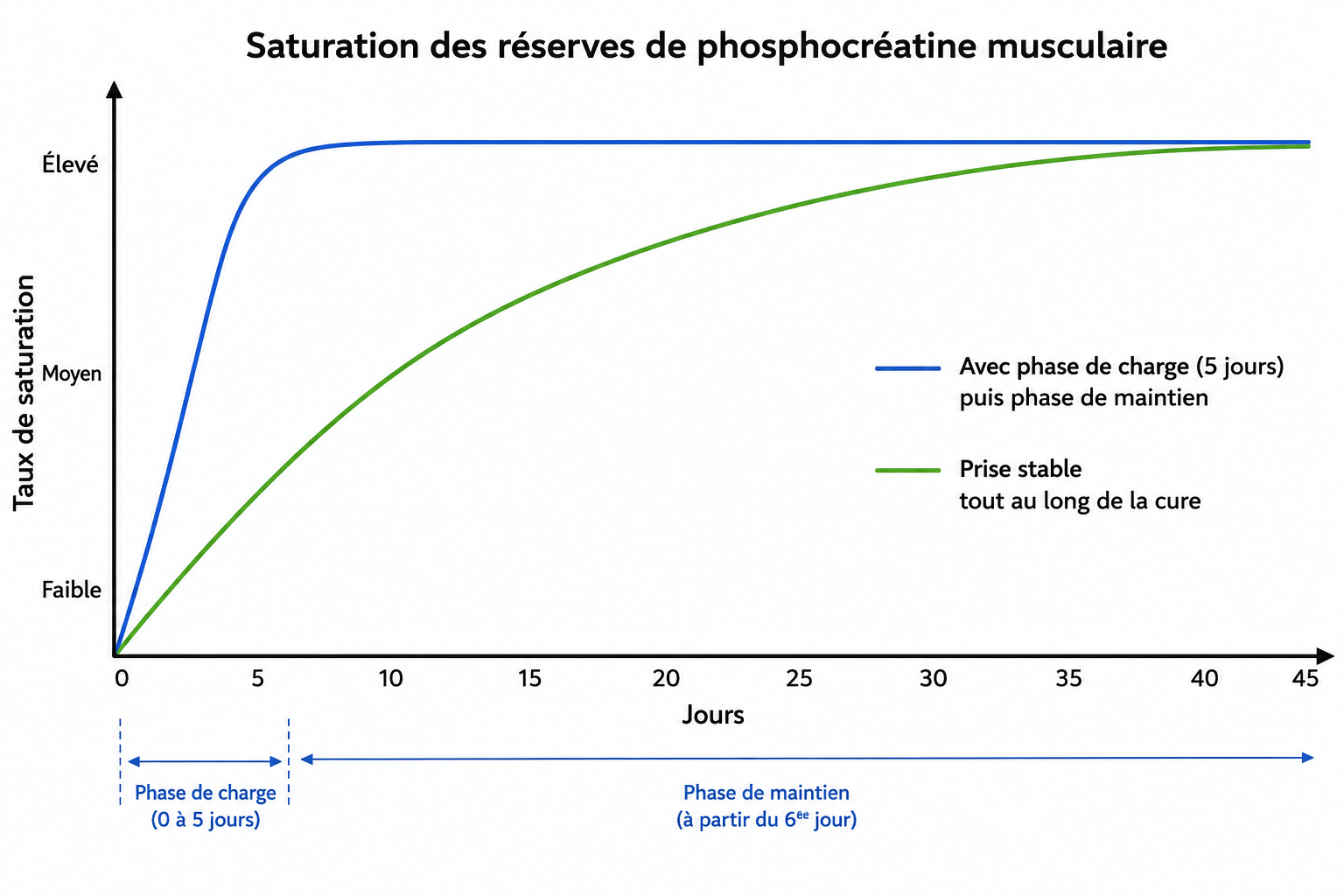
Nothing changes except the rate at which creatine stores become saturated, which is what triggers the effects. With aloading phase, the first effects appearwithin a few days, compared to 2 to 3 weekswithout a prior loading phase. See the illustration below, which shows a simplified theoretical graph:
Why do some people feel the effects sooner?
Some people quickly build up their muscle creatine stores and feel the benefits right away. Others, on the other hand, naturally have higher levels and notice less of a difference.
Therate at whichcreatinetakes effectvaries from one athlete to another. Several factors explain this rate of muscle saturation as well as the sensations experienced during training:
- genetics and muscle mass;
- diet, as vegetarians sometimes have naturally lower levels because creatine is primarily obtained from meat and fish;
- the level of fitness and thebody’s responseto exercise, since an experienced athlete will notice the benefits more easily thana beginner;
- additionalfluid intake, as dehydration affects performance and how the body feels.
In any case, you should follow the recommended dosages and protocol to experience the effects.
Should you do a loading phase with creatine? The benefits
There are many benefits to taking creatine, one of the most effective performance-enhancing supplements for athletes.
Creatine supplementation increasesintramuscular creatinelevels. This increase is believed to lead tobetter adaptationto training, resulting in improvements in high-intensity exercises. This faster gain in strength is linked to a greater ability to perform a higher number of intense efforts.
Beyond athletic performance, supplementation optimizespost-workout recoveryand helps prevent injuries. It even plays a role inrehabilitationandneuroprotectionfor athletes, such as those who have suffered a concussion.
Researchers have also identified significant potential health benefits for people of all ages, particularly in the context of aging.
Side effects of creatine
Possible digestive problems
Athletessometimesreport side effects such as mildgastrointestinal issues. The symptoms described include stomachaches and diarrhea.
Thesedigestive issuesare temporary and harmless. In fact, they are rarely mentioned in studies. In reality, it appears that the cause of these issues is linked toproblems withcreatinedosageand usage. Individual sensitivity and dietary intake also play a role. For example, a high-protein diet is more inflammatory.
Can you gain weight?
While creatine can aid in weight loss, it can also cause weight gain at the start of a supplementation regimen. Supplementation leads tointracellular water retention. This phenomenon can result in an additional weight gain of1 to 2 kglocalized within the muscle.
This weight gain is neither fat nor muscle. It is intracellular water that increases muscle water volume. However, this weight gain visible on the scale quickly disappears once the supplementation period ends.
Is creatine harmful to the kidneys?
The International Society of Sports Nutrition (ISSN) notes that supplementation is safe for healthy individuals of all ages. It even offersnumeroushealthbenefits³. To date, there is no scientific evidence indicating that creatine monohydrate poses a risk to healthy individuals at the recommended doses.
However, caution is advised for individuals with a history of kidney problems or chronic conditions. These individuals should consult a healthcare professional before taking any supplements.
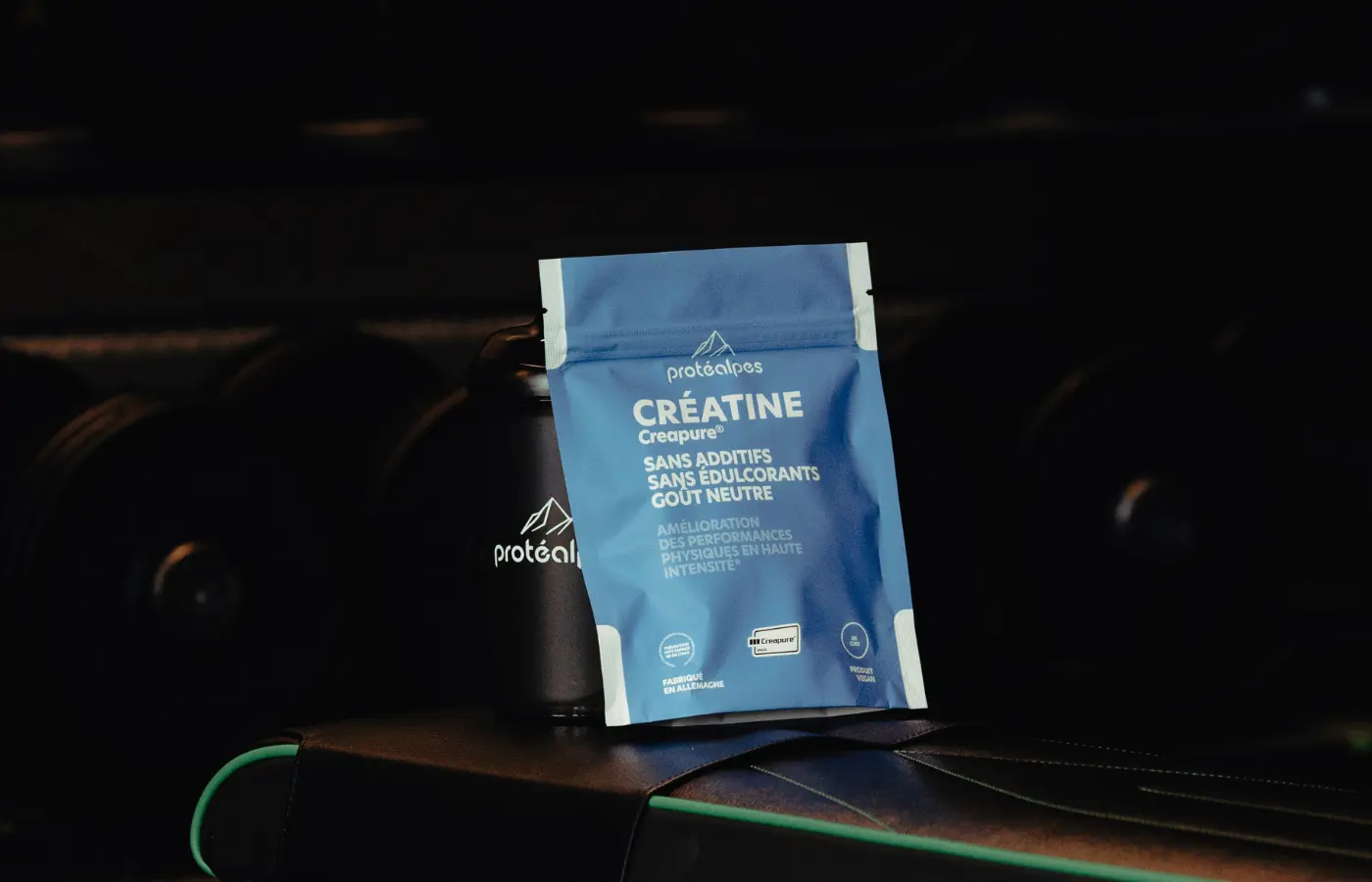
Creatine Creapure®
The best for maximizing muscle power in a healthy way and optimizing intensive performance
- Standardised without doping substances
- No additives, no sweeteners
- Made in Germany, packaged by Protéalpes in Albertville

The importance of the loading phase for the brain
Boost motivation
A loading phase has the advantage of deliveringquick results with visible effects. Actual muscle gain can then lead to increased motivation. The sense of more immediate progress reinforces the desire to keep up the effort.
In fact, science has studied the effects ofmotivationon learning. Although this is in a different context than creatine supplementation, the key takeaway is that the more motivated a person is, the more responsive they are to the feedback they receive². This responsiveness activates a region of the brain that promotes learning.
If we apply this finding to the context of creatine, one might think that the positive effects perceived more quickly during a loading phase would increase the athlete’s motivation.
The psychological effect of “it works”
Creatine may thus enhance the perception of progress andadherenceto the exercise program, thanks to the visible results it produces for the athlete. Consistency in training would be facilitated by a “it works” effect, which can help reinforce exercise habits.
A common bias among practitioners
The risk with a protocol that doesn't include a loading phase is thatyou might stop too soonunder the assumption that it isn't working. It's important to keep in mind that without this step, significant effects tend to appear after about a month—and only if the exercise program is tailored to the creatine regimen.
This is amatter of timing: without understanding how long it takes for creatine to take effect, an athlete might stop taking it too soon and misjudge its benefits.
How should I take creatine on a daily basis?
What is the right dosage of creatine?
The idealdailydose of creatine is3 to 5 grams formost athletes. During a loading phase, the dose is increased to 20 grams per day for 5 to 7 days, but after that, there is no need to take more creatine than necessary.
When should you take creatine?
There are no specific recommendations regarding thebest timeto take creatine. Since its effects are not immediate, the timing doesn’t really matter. The strategy is instead to maintain daily stores once they have been fully replenished.
Before or after training?
There is no recommended ideal time of day to take supplements.Whetheryou take thembefore or after a workoutisn’t the issue, since creatine doesn’t provide an immediate effect. However, to maximize absorption, it may be beneficial to prioritize taking them after exercise, when the body is more receptive to nutrients.
Is it okay to take it every day?
Contrary to the common misconception that you shouldn’t waste your creatine on rest days, consistency is more important than the timing of supplementation. This means you should takecreatine on rest days, as the goal of a supplementation cycle is tomaintainconsistentlyhigh creatine levels.
What should I take creatine with?
Creatine monohydrate is the scientifically recognized form of creatine. It is sold in powder or capsule form, and each option has its pros and cons.
Creatine powder offers good value for money and allows for precise dosing. However, the need to mix it with a liquid makes it less convenient.
Creatine capsules are convenient, but they are more expensive.
Here is a comparison of the two formats:
| Forms of creatine | Benefits 👌🏻 | Disadvantages 👎🏻 |
| Creatine powder | scientifically proven good value for money relatively precise dosages | less portable |
| Creatine capsules | precise doses , convenient size | lower purity higher cost |
3 Mistakes to Avoid When Taking Creatine
- Neglecting product quality
The purity of the powder affects absorption. The only form of creatine scientifically recommended is creatine monohydrate. As such, the Créapure label guarantees high-quality manufacturing.
- Taking less than the recommended daily dose
To ensure the product is as effective as possible, the dosage must follow the recommended guidelines. However, some athletes take too little creatine each day, which prevents them from reaching the desired saturation level.
- Believing in a miracle cure
While creatine is certainly a performance-enhancing supplement, it has no effect on its own without a resistance training program tailored to the athlete. Similarly, lifestyle factors—including sleep, hydration, stress management, and diet—play a role in athletic performance.
FAQ on the creatine loading phase
Should you do a bulking phase when trying to gain muscle?
Yes, you can do a loading phasewhen bulking up, particularly to speed up muscle creatine saturation.
Can you take creatine while cutting?
Creatine is a supplement that aids in muscle definition. It provides the energy needed to perform high-intensity workouts, which are essential for creating the calorie deficit required for muscle definition.
How long before I see results?
With a loading phase, the effects of creatine become noticeable within a few days. Without it, the process takes several weeks. That’s why competitive or professional athletes, who need to quickly replenish their stores, are better off following a loading phase.
Does creatine cause hair loss?
No, creatine does not cause hair loss. This misconception may stem from the risk of cross-contamination with anabolic steroids, which are dangerous and can cause hair loss. That is why it is important to choose creatine manufactured in Europe with the Créapure label to ensure its purity and the absence of unwanted contaminants.
Is the loading phase beneficial for women?
That's right; the loading phase is just as beneficial for women as it is for men. In fact, there's an added benefit to takingcreatine for women, since they naturally have lower creatine levels than men. This results in a relatively greater effect.
Conclusion
To determine whether you should do a creatine loading phase, you first need to understand the two protocols for taking it. The first involves a high dose at the start of the cycle, followed by a maintenance dose until the end of the regimen. This method is particularly beneficial for athletes with tight competition schedules, as it saves time and allows them to reap the benefits more quickly. The second method involves taking a consistent dose throughout the entire course. This protocol is more broadly suitable for all athletes without specific time constraints, or those with digestive sensitivities. At Protéalpes, we often recommend the method involving a consistent daily dose throughout the entire course, which is easier to manage and suits the majority of people.
When deciding between the two, keep in mind that the loading phase speeds up results but is not essential for performance. The benefits are similar at the end of the cycle in both cases, but they are achieved sooner with a protocol that includes an initial loading phase.
Ultimately, the best regimen is one that is followed throughout the entire cycle, even on rest days. The key is consistency in taking the supplement and combining it with a healthy lifestyle to maximize the benefits of the treatment.