






The running pace calculator converts distance traveled and time taken into two essential values: average pace (min/km) and running speed (km/h).
This simple tool helps you plan your training better, analyze your times, estimate your finishing time, or set a realistic goal for a different distance (10K, half marathon, marathon, trail run).
Running pace calculator
Calculate a transit time
At this pace, what would your time be over a different distance?
What exactly is this calculator used for?
The calculator automatically converts:
- a running distance (in meters or kilometers),
- total time (hours/minutes/seconds)
in:
- average speed: km/h,
- pace per kilometer: minutes and seconds per km,
- estimated time over another distance if the pace remains constant.
These conversions are based on the universal formula:
Speed (km/h) = Distance (km) ÷ Time (h)
Pace (min/km) = 60 ÷ Speed (km/h)
These equations are the basis used in running, road competitions, trail running, and even in VMA field tests validated by physiological research.
How can a beginner use it?
Know your true pace
Entering the distance traveled and the time taken allows you to calculate your average pace.
Example: covering 10,000 m in 55 minutes = 5'30/km.
This measurement helps to understand in which intensity zone the effort was made (endurance, close to threshold, etc.).
Estimate a simple running goal
For a time goal over 10 km, half marathon, or marathon, simply enter your target time and let the tool calculate the pace you need to maintain.
For example, if you want to challenge the 10km record set by UgandanJoshua Cheptegei (26 minutes and 38 seconds), the calculator tells us that you need to maintain an average pace of 2 minutes 39 seconds per kilometer...
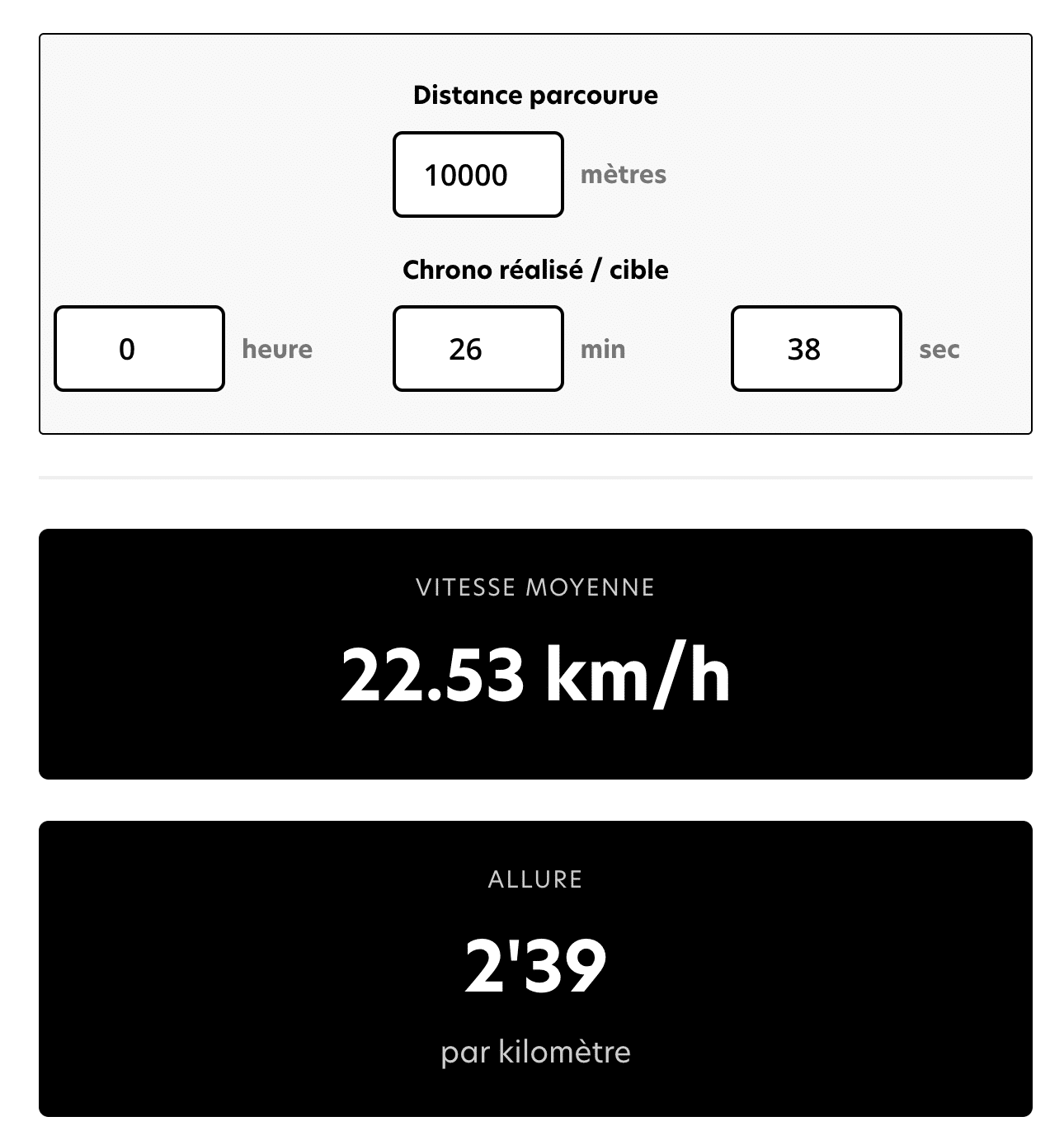
This is used to plan a session, prepare a training plan, or check the consistency of a goal.
Obtain transit times
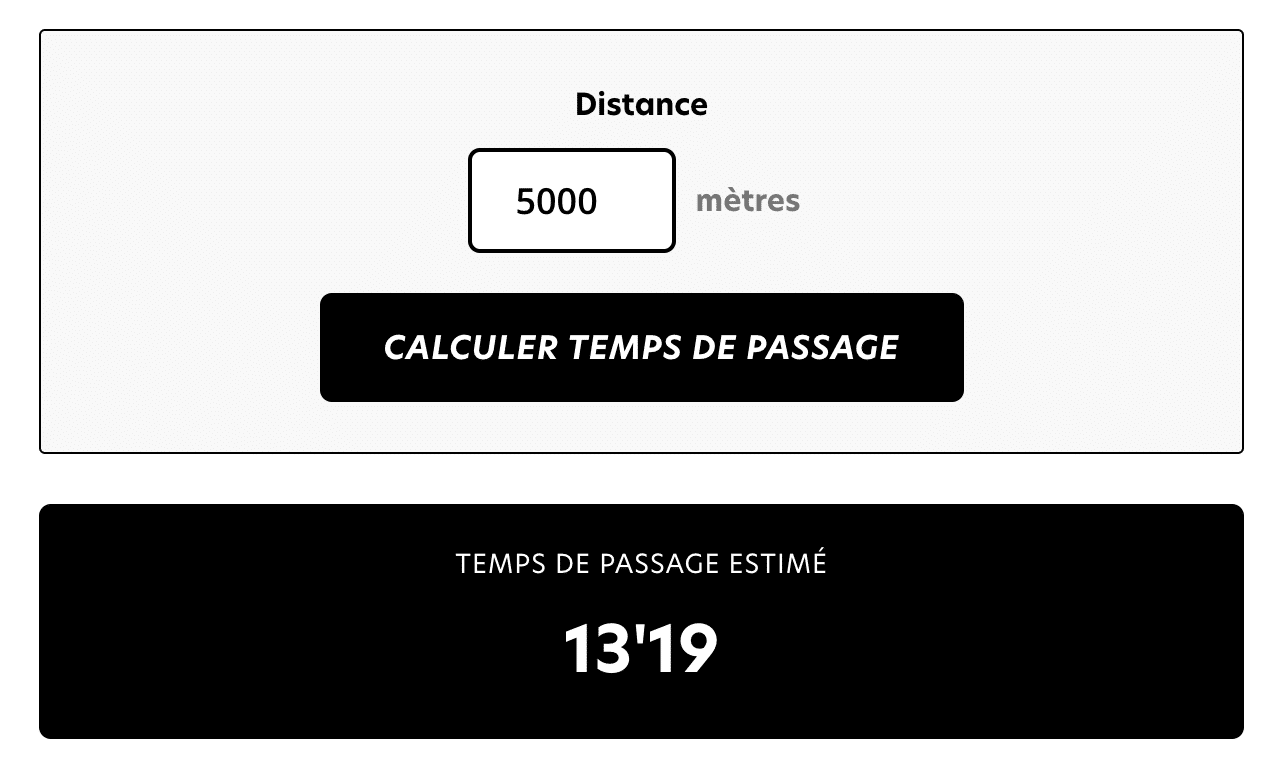
Once the pace is known, the "travel time" module can be used to estimate the time needed to cover a different distance (2 km, 5 km, 12 km, etc.).
Useful for marathons, ultras, cross-country, or trail races where pace must be anticipated.
Limitations to be aware of before using the calculator
Studies show that:
- Speed and pace are reliable indicators of mechanical load and energy cost.
- Critical speed, VMA, and threshold pace are important parameters, but the average pace of a race is a direct reflection of your current endurance level.
- Time estimates based on a constant pace are only accurate over short distances (e.g., predicting 5 km → 10 km is reasonable).
Projections become uncertain when the distance is very different, because fatigue, slope, temperature, experience, or elevation gain greatly affect running speed.
The calculator remains a mathematical simulator, not a physiological tool.
Its limitations:
- assumes a constant pace, which does not reflect the reality of a long distance, a trail, or an ascent/descent;
- does not include any parameters for fatigue, VMA, heart rate, recovery, sleep, or nutrition;
- does not distinguish between target effort and maximum effort;
- does not take terrain into account (road, trail, forest, slope, ultra).
These values should therefore be used as references, not as absolute truths.
Practical tips for better use
- Compare only similar distances (5 km ↔ 10 km, half marathon ↔ marathon).
- Add 3 to 8% time over longer distances: this is what the models developed by Riegel and Daniels show.
- Use consistent data: correctly measured distance (reliable GPS, track, Strava).
- Monitor your daily condition: heat, elevation, wind, and training load can affect your speed.
- Don't ignore recovery: overambitious efforts increase the risk of injury, especially for new runners.
- Always test in real conditions with a GPS watch or a field test (VMA, single 6-minute session, benchmark pace).
In a nutshell
- The running pace calculator is a simple, accurate, and indispensable tool for understanding your pace, converting running speed, planning a session, and estimating your time over a similar distance. Used correctly, it helps you progress, improve your preparation, and calibrate your goals.
- It is a reliable simulator for conversions, but proper training, adequate recovery, and a progressive plan remain essential for successfully completing a marathon, half marathon, or any road, trail, or ultra race.