






Walking is the most universal and oldest form of physical activity known to humankind. Accessible to everyone, requiring no special equipment or technical training, it remains one of the best ways to burn calories on a daily basis, improve cardiovascular health, and maintain a healthy weight.
On average, walking for an hour burns between 150 and 600 kcal, depending on your pace and body weight. For a 70-kg person, this amounts to approximately 257 kcal/hour at a moderate pace (5 km/h), 368 kcal/hour at a brisk pace (6 km/h), and nearly 515 kcal at a very brisk pace (7 km/h and above).
The Protéalpes calculator uses the ACSM formula and MET values from the 2024 Compendium of Physical Activities to estimate your energy expenditure while walking as accurately as possible.
Calculator: How many calories are burned during a walking session?
| Duration | Calories (range) |
|---|---|
| 10 min | 39–49 kcal |
| 20 min | 78–99 kcal |
| 30 min | 116–148 kcal |
| 40 min | 155–198 kcal |
| 50 min | 194–247 kcal |
| 60 min | 233–296 kcal |
| 70 min | 272–346 kcal |
| 80 min | 310–395 kcal |
| 90 min | 349–445 kcal |
| 100 min | 388–494 kcal |
| 110 min | 427–543 kcal |
| 120 min | 466–593 kcal |
| Calories | Duration (range) |
|---|---|
| 50 kcal | 10–13 min |
| 100 kcal | 20–26 min |
| 150 calories | 30–39 min |
| 200 kcal | 40–52 min |
| 250 calories | 51–64 min |
| 300 calories | 61–77 min |
| 350 calories | 71–90 min |
| 400 calories | 81–103 min |
| 450 calories | 91–116 min |
| 500 kcal | 101–129 min |
| Not | Calories (range) |
|---|---|
| 2000 | 67–86 kcal |
| 4000 | 135–172 kcal |
| 6000 | 202–258 kcal |
| 8000 | 270–344 kcal |
| 10000 | 337–429 kcal |
| 12000 | 405–515 kcal |
| 14000 | 472–601 kcal |
| 16000 | 540–687 kcal |
| 18000 | 607–773 kcal |
| 20000 | 675–859 kcal |
| Distance | Calories (range) |
|---|---|
| 1 km | 47–59 kcal |
| 2 km | 93–119 kcal |
| 3 km | 140–178 kcal |
| 4 km | 186–237 kcal |
| 5 miles | 233–296 kcal |
| 6 km | 279–356 kcal |
| 7 km | 326–415 kcal |
| 8 km | 373–474 kcal |
| 9 km | 419–533 kcal |
| 10 km | 466–593 kcal |
| 11 km | 512–652 kcal |
| 12 km | 559–711 kcal |
| 13 km | 605–771 kcal |
| 14 km | 652–830 kcal |
| 15 km | 699–889 kcal |
| 16 km | 745–948 kcal |
| 17 km | 792–1,008 kcal |
| 18 km | 838–1,067 kcal |
| 19 km | 885–1,126 kcal |
| 20 km | 931–1,185 kcal |
| 21 km | 978–1,245 kcal |
| 22 km | 1,025–1,304 kcal |
| 23 km | 1,071–1,363 kcal |
| 24 km | 1,118–1,422 kcal |
| 25 km | 1,164–1,482 kcal |
How many calories do you actually burn while walking?
The number of calories burned during a walking session depends on three key factors:
- body weight expressed in kilograms;
- walking speed (and thus the intensity of the effort);
- the total duration of the activity.
The standard formula used in exercise physiology is as follows:
kcal/min = MET × 3.5 × weight (kg) ÷ 200
The MET (Metabolic Equivalent of Task) measures the energy cost of an activity relative to resting metabolism. A value of 1 MET corresponds to resting energy expenditure, which is approximately 1 kcal per kilogram of body weight per hour.
Note: For a 70-kg person walking at a moderate pace (3.5 METs), energy expenditure is approximately 4.3 kcal/min, or nearly 260 kcal over 60 minutes. This is more than a gentle yoga session, but significantly less than a run at 10 km/h, which burns around 700 kcal/h for the same person.

What MET value corresponds to your walking pace?
Studies in the 2024 Compendium of Physical Activities assign a specific MET value to each walking pace. As speed increases, energy expenditure per minute rises, approaching that of jogging at speeds above 7 km/h.
| Type of walk | Typical speed | MET | kcal/min (70 kg) |
|---|---|---|---|
| Slow walk (stroll, leisurely walk) | < 3 km/h | 2,8 | ≈ 3,4 |
| Moderate walking (brisk walking pace) | 4–5 km/h | 3,5 | ≈ 4,3 |
| Brisk walking (power walking) | 5.5–6.5 mph | 5,0 | ≈ 6,1 |
| Very fast walking (almost jogging) | ≥ 7 mph | 7,0 | ≈ 8,6 |
| Nordic walking (with poles, at a brisk pace) | 5–6 mph | 6,8 | ≈ 8,3 |
Nordic walking deserves special attention: the use of poles to engage the arms significantly increases energy expenditure compared to regular walking at a similar pace. It thus comes close to the energy expenditure of a slow jog.
How many calories do you burn depending on how long you walk?
Duration remains the simplest way to increase total calorie expenditure. Doubling the walking time—at a constant speed and on a constant terrain—effectively doubles the energy expended.
The table below shows estimates for a 70-kg person on flat ground:
| Duration | Brisk walking (2.8 MET) | Moderate walking (3.5 METs) | Brisk walking (5 METs) | Very brisk walking (7 MET) |
|---|---|---|---|---|
| 15 min | ≈ 51 kcal | ≈ 64 kcal | ≈ 92 kcal | ≈ 129 kcal |
| 30 min | ≈ 103 kcal | ≈ 129 kcal | ≈ 184 kcal | ≈ 257 kcal |
| 40 min | ≈ 137 kcal | ≈ 172 kcal | ≈ 245 kcal | ≈ 343 kcal |
| 1 h | ≈ 206 kcal | ≈ 257 kcal | ≈ 368 kcal | ≈ 515 kcal |
| 1 hour and 30 minutes | ≈ 309 kcal | ≈ 386 kcal | ≈ 551 kcal | ≈ 772 kcal |
| 2 h | ≈ 412 kcal | ≈ 515 kcal | ≈ 735 kcal | ≈ 1,029 kcal |
| 3 h | ≈ 617 kcal | ≈ 772 kcal | ≈ 1,103 kcal | ≈ 1,544 kcal |
Disclaimer: These values are estimates only. Actual energy expenditure varies depending on body composition, heart rate, fitness level, outdoor temperature, and the consistency of your pace. The figures are based on a healthy adult weighing 70 kg.
How many calories do you burn based on the distance traveled?
Thinking in terms of kilometers traveled provides a useful benchmark, especially for walkers who are following a set route or planning a hike. A simple and reliable rule of thumb from the physiological literature suggests that walking at a moderate pace burns approximately 0.5 kcal per kilogram of body weight per kilometer traveled.
The following table shows the estimated energy expenditure based on weight and distance for a moderate walk (5 km/h, flat terrain):
| Distance | 55 kg | 65 kg | 70 kg | 80 kg | 90 kg |
|---|---|---|---|---|---|
| 3 km | 83 calories | 98 calories | 105 calories | 120 calories | 135 calories |
| 5 miles | 138 calories | 163 calories | 175 calories | 200 kcal | 225 calories |
| 6 km | 165 calories | 195 calories | 210 calories | 240 calories | 270 calories |
| 10 km | 275 calories | 325 calories | 350 calories | 400 calories | 450 calories |
| 15 km | 413 calories | 488 calories | 525 calories | 600 calories | 675 calories |
| 20 km | 550 calories | 650 calories | 700 calories | 800 kcal | 900 kcal |
Does walking on an incline burn more calories?
The answer is a resounding yes. The ACSM equation for treadmill walking explicitly includes the incline:
VO₂ (ml/kg/min) = 0.1 × speed + 1.8 × speed × gradient + 3.5
This formula shows that the energy cost of climbing a slope is eighteen times greater than that of covering an equivalent horizontal distance. In other words, climbing 5 meters in elevation is energetically equivalent to walking 90 meters on flat ground.
The table below shows the effect of incline when walking at 5.5 km/h for a person weighing 70 kg:
| Tilt | Estimated MET | kcal/min | kcal per hour |
|---|---|---|---|
| 0% (flat) | 4,3 | 5,3 | ≈ 315 kcal |
| 3 % | 5,5 | 6,7 | ≈ 405 kcal |
| 6 % | 6,8 | 8,3 | ≈ 500 kcal |
| 9 % | 8,1 | 9,9 | ≈ 595 kcal |
| 12 % | 9,4 | 11,5 | ≈ 690 kcal |
Additional information: One hour on a treadmill at 5.5 mph with a 12% incline burns as many calories as jogging at 10 mph on flat ground, while being easier on the joints. This is one of the most effective ways to increase the intensity of a walking workout without switching to running.
How does the walking calorie calculator work?
The Protéalpes tool offers three data entry modes to suit all types of hikers.
Duration mode: the most straightforward
Enter your weight, the duration of your session, and the intensity (slow, moderate, fast, very fast). The calculator applies the ACSM formula using the corresponding MET value. This is the simplest way to get a quick estimate after a walk or a brisk walking session.
Distance and Speed Mode
If you know the distance traveled (in kilometers) and your average speed, the calculator automatically calculates the duration and then applies the MET formula. This mode is ideal for analyzing a specific route (a loop in the forest, a commute, or a planned hike).
Step Count Mode
For users of pedometers or smartwatches, the calculator first estimates stride length based on height:
Stride length (m) = height (m) × 0.414
It then calculates the distance traveled, the walking time at the specified speed, and finally the calorie expenditure using the MET formula. This approach is consistent with the one used by major fitness platforms and epidemiological studies on daily step counts.
Note: Step estimation is only an approximation. Actual stride length varies depending on body type, leg length, pace, and terrain. A fast walker has a longer stride than a slow walker, even if they are the same height.

Does walking really help you lose weight?
Walking is one of the most effective long-term activities for promoting fat loss. Its main advantage lies in its sustainability: unlike high-intensity exercises such as burpees or continuous squats, it can be done every day without causing excessive fatigue or increasing the risk of injury.
The following table compares walking to other endurance activities for a person weighing 70 kg:
| Activity | MET | kcal/min | kcal per hour |
|---|---|---|---|
| Marche lente (< 3 km/h) | 2,8 | 3,4 | ≈ 206 kcal |
| Moderate walking (5 mph) | 3,5 | 4,3 | ≈ 257 kcal |
| Brisk walking (6.5 mph) | 5,0 | 6,1 | ≈ 368 kcal |
| Nordic walking | 6,8 | 8,3 | ≈ 498 kcal |
| Moderate cycling (16–19 km/h) | 6,8 | 8,3 | ≈ 498 kcal |
| Slow jogging (8 km/h) | 8,3 | 10,2 | ≈ 610 kcal |
| Swimming (moderate front crawl) | 8,0 | 9,8 | ≈ 588 kcal |
| Jump rope (moderate pace) | 11,0 | 13,5 | ≈ 810 kcal |
Walking burns fewer calories per minute than running or intense cycling, but it allows for much longer sessions without putting stress on the joints. A daily brisk 45-minute walk at 6 km/h burns about 275 calories per day, or nearly 2,000 calories per week (a significant calorie deficit if your diet remains unchanged).
Warning: No amount of physical activity alone can compensate for overeating. Sustainable weight loss relies primarily on a controlled calorie deficit, achieved by moderately reducing calorie intake and gradually increasing physical activity.
To estimate your daily energy needs, the basal metabolic rate calculator and the daily calorie needs calculator are good places to start.
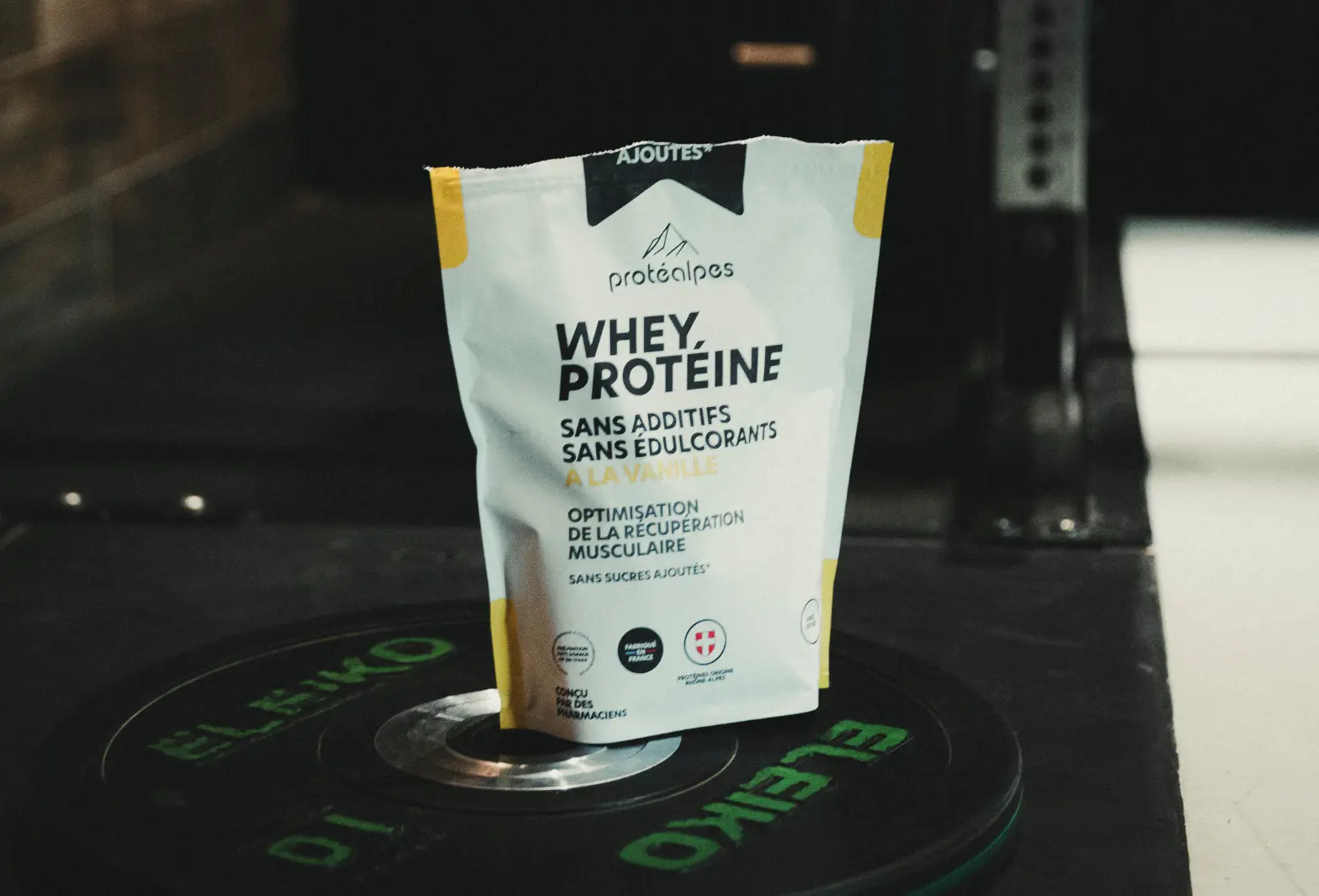
High-quality sugar-free proteins
- Cold microfiltration
- Optimal digestibility
- Unsweetened flavor
- Without performance-enhancing substances
- Gluten-free
How can you maximize calorie burn during your walks?
There are several ways to significantly increase energy expenditure without turning walking into running:
- increase your pace beyond 5.5 km/h to enter the sustained-intensity zone and nearly double your energy expenditure compared to a leisurely stroll;
- Incorporate an incline: a few hills or a treadmill set at a 6–9% incline are enough to raise the MET value to 7 or 8;
- practice Nordic walking with poles to actively engage the upper body;
- carrying a backpack (5 to 10 kg) while hiking: the extra weight proportionally increases energy expenditure;
- Aim for consistency: 7,000 to 10,000 steps a day is an excellent goal for cardiovascular health and weight maintenance;
- Alternate between brisk walking and moderate walking during the same session to incorporate a light interval training effect, which is beneficial for cardiorespiratory fitness.
For walkers looking to lose weight or improve their body composition, walking should ideally be part of a broader routine that combines strength training, an appropriate amount of cardio, and a balanced diet.
Adequate protein intake helps preserve muscle mass during a calorie deficit, which is key to avoiding the yo-yo effect and keeping your metabolism high.
Whey made in France
- High in protein, no stimulants, no sucralose, gluten-free
- Contributes to muscle maintenance and growth
- Optimal recovery thanks to post-workout carbohydrates
- Cold-microfiltered whey isolate, without heat treatment
- Milk from Rhône-Alpes pastures, produced in Albertville
To take a closer look at your energy consumption
Walking accounts for only a portion of total energy expenditure. To refine your approach, several complementary tools may be helpful:
- the energy balance calculator for tracking calorie intake and expenditure;
- the BMI calculator and waist-to-hip ratio to assess your body composition;
- the ideal weight calculator to set a realistic goal;
- the maximum heart rate calculator and the VO2 max calculator to help you identify your training zones;
- thebasic endurance calculator if you want to improve your running.
For walkers who use walking as a weight-loss tool, understanding thermogenesis, the effects of cardio on the body, and fasting cardio can help optimize their workouts. Those with more ambitious goals can check out our guide to losing 1 kg in a week in a healthy and sustainable way.
Scientific references and sources
2ACSM’s Guidelines for Exercise Testing and Prescription by American College of Sports Medicine
3Compendium of Physical Activities: a second update of codes and MET values by Barbara E. Ainsworth et al.
4Energy cost of walking and running on extremely steep uphill and downhill slopes by Alberto E. Minetti et al.
5Association between step volume and intensity and all-cause mortality in older women by I-Min Lee et al.
Our other calculators