




According tothe World Health Organization, nearly one-third (31%) of adults worldwide—or about 1.8 billion people—did not engage in physical activity at the recommended levels in 2022.
At the same time, adults in industrialized countries walk an average of 4,000 to 5,000 steps per day, far short of the 7,000 to 10,000 steps often recommended by health authorities. The WHO recommends that adults engage in at least 150 minutes of moderate-intensity physical activity per week. This is a goal that daily walking makes it easy to achieve, provided you know how to convert your steps into kilometers.
The standard formula for converting steps to kilometers is simple: distance (km) = number of steps × stride length (m) ÷ 1000.
Given an average stride length of 0.67 meters for women and 0.76 meters for men, 10,000 steps equate to a distance of between 6.7 and 7.6 kilometers.
Step-to-kilometer converter
| Not | Distance |
|---|---|
| 1000 | 0.70 km |
| 2000 | 1.40 km |
| 3000 | 2.10 km |
| 4000 | 2.80 km |
| 5000 | 3.50 km |
| 6000 | 4.20 km |
| 7000 | 4.90 km |
| 8000 | 5.60 km |
| 9000 | 6.30 km |
| 10000 | 7.00 km |
| 11000 | 7.70 km |
| 12000 | 8.40 km |
| 13000 | 9.10 km |
| 14000 | 9.80 km |
| 15000 | 10.50 km |
| 16000 | 11.20 km |
| 17000 | 11.90 km |
| 18000 | 12.60 km |
| 19000 | 13.30 km |
| 20000 | 14.00 km |
| km | Not |
|---|---|
| 1 km | 1,429 steps |
| 2 km | 2,857 steps |
| 3 km | 4,286 steps |
| 4 km | 5,714 steps |
| 5 miles | 7,143 steps |
| 6 km | 8,571 steps |
| 7 km | 10,000 steps |
| 8 km | 11,429 steps |
| 9 km | 12,857 steps |
| 10 km | 14,286 steps |
| 11 km | 15,714 steps |
| 12 km | 17,143 steps |
| 13 km | 18,571 steps |
| 14 km | 20,000 steps |
| 15 km | 21,429 steps |
| 16 km | 22,857 steps |
| 17 km | 24,286 steps |
| 18 km | 25,714 steps |
| 19 km | 27,143 steps |
| 20 km | 28,571 steps |
To refine this result, calculating your average running speed can help you better understand the relationship between distance and pace.
How do you convert steps to kilometers?
The conversion is based on a basic kinematic relationship, in which only stride length affects the result. Three levels of precision are commonly cited in the literature: the generic average,the adjustment by sex, andthe estimate by height.
Note: Stride length can vary by ±20% between two people of the same build, depending on stride rate, walking style, and physical condition.
What is the average length of a step?
Population-based values average around 0.67 m for women and 0.76 m formen.¹ These reference values, used by most conversion tools, provide a reliable estimate for adults without personal measurements.
| Number of steps | Woman (0.67 m) | Man (0.76 m) |
|---|---|---|
| 1 000 | 0.67 km | 0.76 km |
| 5 000 | 3.35 km | 3.80 km |
| 10 000 | 6.70 km | 7.60 km |
| 15 000 | 10.05 km | 11.40 km |
How can you estimate your stride length based on your height?
A more personalized approach involves relating stride length to height using an empirical coefficient:
- Common formula: stride length (cm) = height (cm) × 0.4
- Simplified formula: stride length (cm) = height (cm) × 0.3875
These coefficients reflect the anthropometric correlation between height and stride length, but do not account for individual characteristics such as hip flexibility or preferred stride rate.
How can you accurately measure your stride length?
The direct method remains the most rigorous way to obtain a custom value:
- mark a starting point on a flat surface;
- walk at a normal pace for 20 steps;
- measure the total distance traveled in meters;
- divide this distance by 20 to get the average length;
- Repeat the process three times and calculate the average.
How many kilometers is 1,000, 5,000, or 10,000 steps?
The table below lists the pace-to-distance equivalents for various profiles, which are useful for tracking daily progress or planning a run.
| Not | Woman, 5'3" | Man, 5'9" | Average adult |
|---|---|---|---|
| 2 000 | 1.28 km | 1.52 km | 1.40 km |
| 5 000 | 3.20 km | 3.80 km | 3.50 km |
| 7 500 | 4.80 km | 5.70 km | 5.25 km |
| 10 000 | 6.40 km | 7.60 km | 7.00 km |
The 10,000-step threshold, popularized in the 1960s by a Japanese marketing campaign, is not a strict scientific benchmark. Recent meta-analyses indicate that significant cardiovascular benefits begin to appear with as few as 6,000 to 8,000 steps per day in adults.
This conversion also makes it possible to link physical activity to energy expenditure: a 70-kg adult burns approximately 0.04 kcal per step at a moderate pace.
For a more precise estimate, the basal metabolic rate calculator and the energy balance calculator are useful additions to this approach, while the daily calorie needs calculator helps adjust food intake.
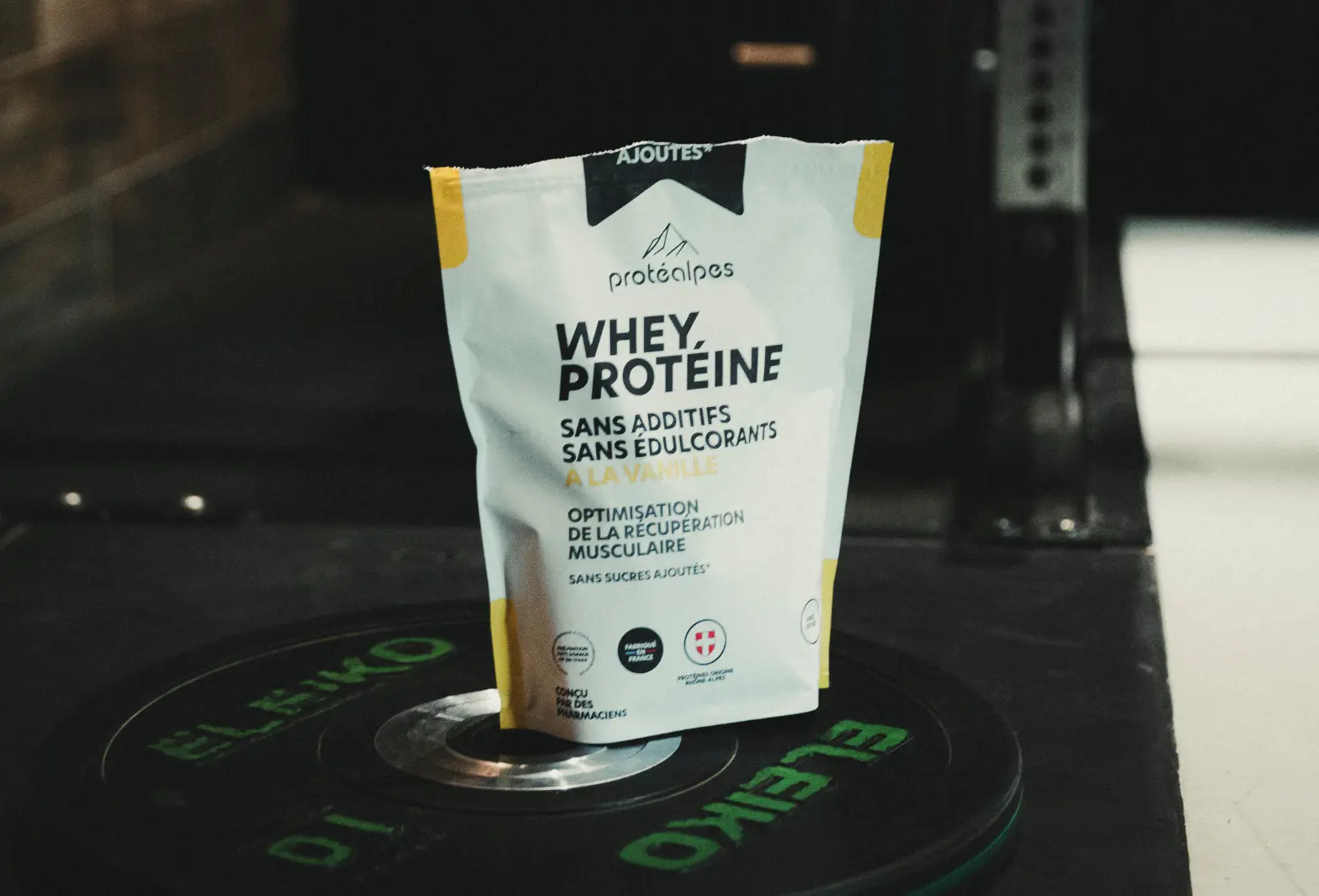
High-quality sugar-free proteins
- Cold microfiltration
- Optimal digestibility
- Unsweetened flavor
- Without performance-enhancing substances
- Gluten-free
What factors affect stride length?
Several factors influence stride length, sometimes significantly:
- size: directly correlated with the length of the hind limbs;
- sex: differences in pelvic structure and segmental ratios;
- Age: a gradual shortening of stride length after age 60;
- Pace: A brisk walk naturally lengthens your stride;
- the terrain: slopes, sand, or uneven ground reduce stride length;
- The shoe: heel-to-toe drop, cushioning, and stiffness all affect propulsion;
- fatigue: reduced range of motion over long distances.
For a runner, these factors become even more significant: energy expenditure during running,running pace, and average speed provide additional benchmarks.
What are the limitations of the steps-to-kilometers converter?
A converter is always a statistical estimate, never a calorimetric or GPS measurement. Intra-individual variability (even for a single person, depending on whether they are strolling or walking briskly) can result in differences of 10 to 15% between two identical routes.
Note: The results are approximate. For greater accuracy (within ±5%), only an on-device GPS measurement (watch, smartphone) or a map reading can be relied upon.
Conversion remains a valuable tool for daily tracking, whether to compare weeks or set incremental goals.
It fits well into a comprehensive approach, alongside the BMI calculator, calories burned while cycling, and performance benchmarks such asmarathon estimates and half-marathon paces for endurance athletes.
Scientific references and sources
22024 Adult Compendium of Physical Activities: A third update of the energy costs of human activities by Stephen D. Herrmann et al.
3ACSM metabolic equations for walking and running on a treadmill by American College of Sports Medicine