





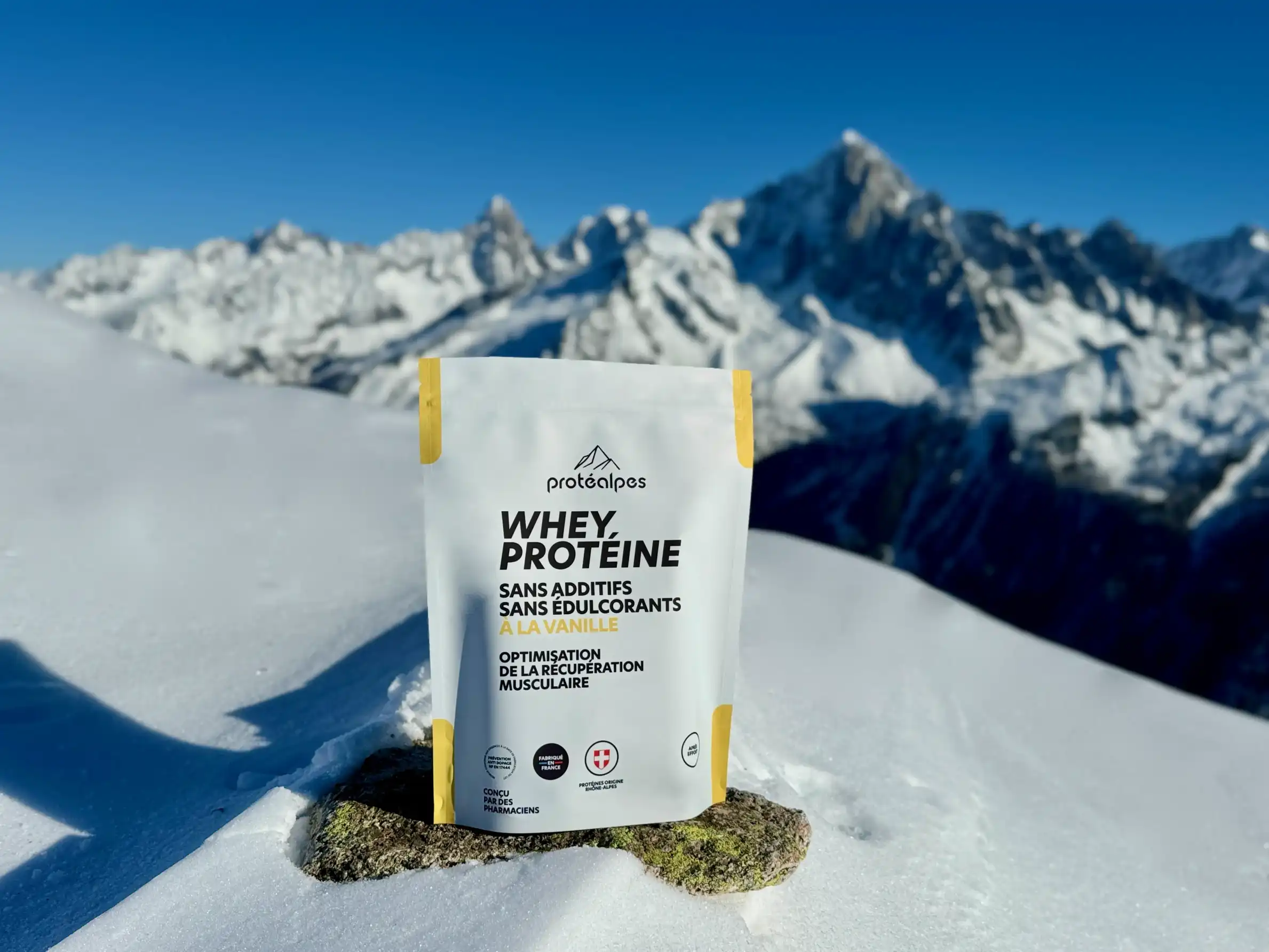
Whey, also known as whey protein , is the protein found in whey, the watery part of milk that separates from the curds during cheese production. It is commonly used as a protein supplement by athletes.
Key points to remember about whey
- Whey is a protein derived from whey that is suitable for a variety of sporting purposes: bodybuilding, endurance sports, recovery...
- It contains the 9 essential amino acids needed for the body to function properly
- Protein powder offers a fast, convenient source of nutrition
- Whey is rapidly assimilated by the body after consumption.
- Your daily intake of whey depends on your diet and your needs.
- Isolate offers higher protein content with lower lactose content
- Powder quality depends on the manufacturing method used
- The shaker remains the most practical tool for quick preparation and consumption.

Contents
- Key points to remember about whey
- What is whey used for?
- Who should take whey?
- What are the real benefits of whey?
- Weight gain
- Weight loss and dryness
- Healing
Whey's high protein content provides substantial quantities ofessential amino acids. There are 9 essential amino acids required for the body to function properly. The best known are tryptophan, isoleucine, lysine, methionine, threonine, valine, leucine, phenylalanine and histidine.
| Name | Main role |
|---|---|
| Tryptophan | Precursor of serotonin (mood, sleep) |
| Isoleucine | Muscle energy, recovery |
| Leucine | Muscle synthesis (key to anabolism) |
| Valine | Muscle energy, tissue regeneration |
| Lysine | Tissue growth, calcium absorption |
| Methionine | Detoxification, healthy hair and nails |
| Threonine | Immune support, tissue elasticity |
| Phenylalanine | Precursor of dopamine and adrenaline |
| Histidine | Growth, tissue repair, histamine production |

What is whey used for?
That's right, why take whey? Isn't our diet high enough in protein as it is?
Whey is a supplementary source of protein and can improve the macro-nutrient content of the diet, as well as having effects on the immune system. We'll come back to its benefits in the next section.
For now, just remember that people commonly use whey protein to achieve a diet that is more suited to their lifestyle or athletic goals. In most cases, the ultimate goal is to improve performance and increase muscle recovery. Others consume it to gain weight or lose fat by adapting their training regimen.
| Objective | Whey type / consumption | Desired effect |
|---|---|---|
| Weight gain | Whey gainer (rich in carbohydrates and calories) | Increase total energy intake |
| Dry / weight loss | Whey isolate with no added sugar (low in sugar and fat) | Maintain muscle mass while cutting calories |
| Muscle recovery | Whey isolate post-workout | Repair fibers and optimize protein synthesis |
| Maintenance or food supplement | Whey isolate (standard) | Cover daily protein requirements |

Who should take whey?
Bear in mind that if your protein intake is already high, adding whey protein to your current intake may be totally unnecessary. In fact, most people can get enough protein from a healthy and varied diet.
However, if you find it difficult to meet your daily protein requirements due to a health problem or intensive sports training, ask your doctor if whey could be useful for you. See the following articles for help:
- Which whey should you choose for running?
- How do you choose your whey when you're a beginner?
- Which whey is right for top-level athletes?
As far as quantities are concerned, it is advisable to follow the serving instructions on the packaging. Finally, top-level athletes should be particularly vigilant about the risks of doping induced by taking protein powder, and choose, among others, products made in France and validated by AFNOR.

What are the real benefits of whey?
Research into the use of whey proteins for specific conditions and activities shows several advantages.
Depending on your condition and your goals, you won't select the same type of whey. However, changing your diet always has an impact on your health, so it's always advisable to choose a whey without additives or sweeteners.
Muscle recovery
First of all, whey protein could help speed up muscle recovery after intense exercise. This is the best-known effect and the main reason why athletes take protein supplements.
Weight gain
The right type of whey (gainer) can help weight gain in people who have difficulty gaining and keeping weight, such as the elderly or people with HIV/AIDS. Taking whey won't make you fat, but it can facilitate healthy metabolic function.
Weight loss and dryness
But in other cases, whether purely for aesthetic reasons, or when training for a competition, athletes can capitalize on the appetite-suppressant effect of protein. This makes it easier for them to achieve their slimming objectives and help them lose weight.
In this case, athletes will tend to opt for a sugar-free whey to reduce their calorie intake as much as possible.
Healing
Thanks to their essential amino acid content, whey has been shown to be beneficial for wound healing. This is particularly useful for people recovering from burns and those with chronic wounds.
Finally, hydrolyzed formulas contain proteins that have been broken down into smaller particles than those found in cow's milk and soy formulas. Research shows that infants fed a hydrolyzed form of whey protein are less likely to develop atopic dermatitis (eczema) than infants fed a standard formula.

How do I take whey?
Ideally, consume 20-30 g of whey within two hours of training.
Whey - usually in powder form - can be added to liquids(milk and water) or soft foods, such as applesauce, or blended with ice and fresh fruit to make a smoothie.
Full details are in our article on how to take whey, but it's often taken in a shaker. You can use a bottle of water and crushed ice to mix it if you don't have one. You know who can take it, how to take it and why, but you don't necessarily know when to take whey.
Overall, the sooner you can increase your protein intake after your workout, the better. In general, you havea two-hour window called the anabolic window after training to consume a protein and carbohydrate meal and recharge your body.
Should whey be taken with milk or water?
There are no hard and fast rules. If you're overweight, take whey protein with water. If you're underweight, take it with milk, and if you're slim and fit, the choice is yours: take it with water or with milk. If you need to, read our article on whey that foams when shaken.
| Objective | Recommended fluid | Why |
|---|---|---|
| Weight loss | Water | Less calories |
| Weight gain | Milk | Additional energy intake |
| Maintenance | Milk or water | According to taste and tolerance |

How is whey made?
When discovering the world of dietary supplements, one subject that comes up regularly is that of side effects. So is whey dangerous for your health?
Remember that when taken correctly and without chemical additives, wheys are safe and can help you build muscle and strength, lose weight, reduce your appetite and boost your metabolism.
That said, it's always worth looking at how it's made, to understand that whey is simply a product derived from filtered milk.
In fact, the start of the whey or casein production process is the same as that for cheese. Once the milk has passed quality tests, enzymes are added to separate the curds from the liquid whey.
The liquid whey is then pasteurized and the protein concentrated and isolated. The two main methods for achieving this are membrane filtration and ion exchange technology.
| Method | Principle | Benefits | Disadvantages |
|---|---|---|---|
| Membrane filtration | Cold separation through porous membranes | Very low lactose and fat content Preserves sensitive peptides and micronutrients Preserves natural protein structure | Slightly lower protein purity, therefore possible traces of lactose/minerals |
| Ion exchange | Electric charge insulation in an exchange column | Pure, highly concentrated protein Virtually lactose- and fat-free | May degrade or lose certain peptides and bioactive micronutrients (specific nutritional loss) Possible loss of certain natural flavors |
Membrane filtration is a cold separation process using porous membranes. Thanks to their different pore sizes, membranes are capable of eliminating bacteria, degreasing whey by preventing (larger) lipids from passing through the membrane, allowing carbohydrates and minerals to pass through, and retaining whey proteins.
Ion exchange is a process for selectively isolating specific protein components.Raw whey is sent through a column which collects the proteins and separates them according to differences in their net charge. The remainder (lactose and minerals) is washed out and transformed into another ingredient.
To find out more about how whey is made, here's an article entitled "Is our whey organic?" which looks at the manufacturing process and what goes into it.