





Long perceived in France as a banned substance, creatine has even come to be associated with doping, extreme muscle mass gain, or health risks. It has sparked much debate and fueled various fears within the sports community.
In reality, this dietary supplement is now one of the most extensively studied substances in the world in the field of sports nutrition. Its effectiveness in improving certain explosive efforts, increasing muscle strength and power, or promoting recovery is proven by numerous scientific studies.
So why does the confusion persist? Because we have to factor in the political and historical context. Between French regulations, medical opinions, and a cultural distrust of supplements, the confusion remains. Creatine is still sometimes viewed as a performance-enhancing drug.
In reality, what does the current French legal framework say? What is fueling the confusion? What is the position of health authorities? It is time to separate fact from fiction to determine when to use creatine and for what purpose. This is an opportunity to show that the question is not whether creatine is banned, but rather how to use it effectively .
In a nutshell
- Creatine is not a performance-enhancing drug.
- It has been approved for sale in France since 2006.
- It is effective in improving physical performance, building muscle mass, and promoting recovery after certain types of exercise.
- The risks mainly concern product quality.
- Not all athletes necessarily need it.
Contents
- Why is there so much confusion about creatine in France?
- A position that differs from the rest of Europe
Why is there so much confusion about creatine in France?
A reputation linked to doping
Creatine has long been mistakenly regarded as a performance-enhancing drug. In early 2001, it was classified by the AFSSA (now known as ANSES) as adangerous and carcinogenic substance. This sparked a major debate at the time, and the French government’s position was to classify creatine as a performance-enhancing drug.
It must be said that at that time, and even as early as the 1990s, doping scandals were breaking out, such as the Festina affair during the 1998 Tour de France.Confusionbetween muscle-building and doping is common and persists, as seen in the scandal involving Laurent Manaudou in 2014 when he admitted to using creatine. This type of event greatly influences the public perception of dietary supplements.
A position that differs from the rest of Europe
Due to a misinterpreted study and the findings of the AFSSA’s review of studies, France long restricted the sale of creatine. Marie-George Buffet, Minister of Sports in the early 2000s,opposed the product, despite the contrary opinion of the International Olympic Committee (IOC) and Europe. Other countries in Europe and around the world allow the sale of creatine and are more comfortable with its use, particularly in the sports world.
It wasn’t until 2012 that the European Food Safety Authority (EFSA) recognized thatcreatine improves performanceata dose of 3 g/day for intense exercise performed by adults. In 2017, the same authority concluded thatcreatine intake, combined with resistance training, contributes to improved muscle strength in adults over 55¹.
In 2024, it refuted the idea that creatine supplementation is linked to improvedcognitive function². However, the International Society of Sports Nutrition (ISSN) states that, in addition to athletic performance, science shows that supplementation promotes:
- post-exercise recovery;
- injury prevention;
- thermoregulation;
- rehabilitation;
- neuroprotection in cases of concussion and/or spinal cord injury³.
Similarly, the Australian Institute of Sport (AIS) notes that its benefits for brain health include improved cognitive function, a potential reduction in injury, and faster recovery following a mild head injury.
Is creatine banned in France today?
The legal framework for creatine in France
In France, creatine has been available over the counter since 2006.
However, even if it is sold, creatine is not necessarily approved by the authorities. The DGCCRF and health authorities such as ANSES monitor supplements, their labeling, and their claims to assess risks and alert the public.
It is also important to note thatdietary supplements donot require a Marketing Authorization(MA) like medications do. It is therefore important to distinguish between implied approval and official validation.
Why are we still talking about a ban?
They are becoming increasingly rare, but some websites still point the finger at creatine. For example, they highlight what is or isn’t recognized by French authorities without taking the scientific consensus into account.
The influence of outdated content on the web and certain misconceptions surrounding the topic continue to cause confusion.
Is it legal to buy creatine in France?
The sale of creatine islegal in France. It is available in its pure form at pharmacies, in stores specializing in sports nutrition, and online.
Some products are imported from abroad, which, depending on the country of origin, can compromise product quality. It is therefore recommended to choose French or European products, such as Créapure creatine (Germany), whose label guarantees absolute purity.
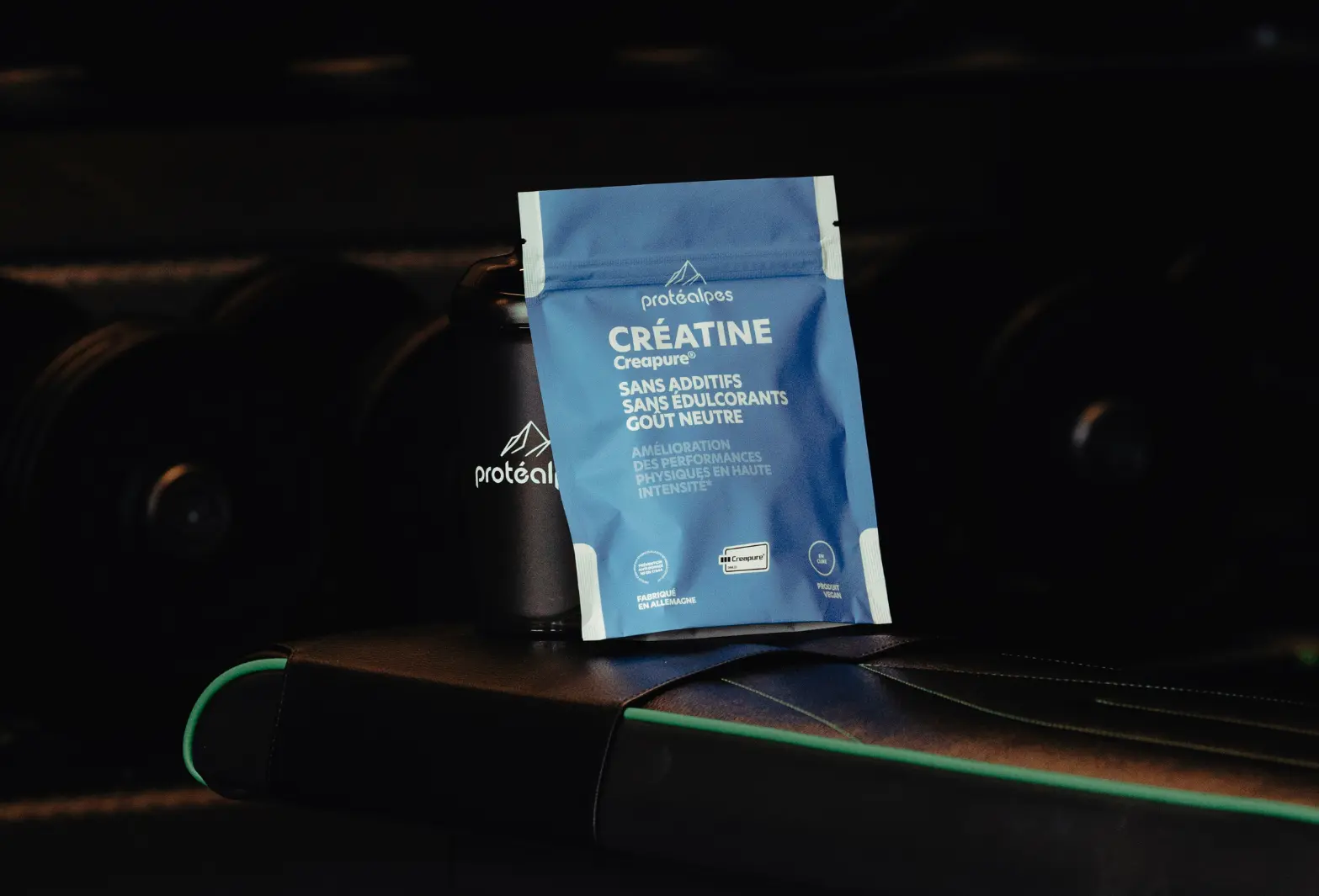
Creatine Creapure®
- Standardised without doping substances
- No additives, no sweeteners
- Made in Germany, packaged by Protéalpes in Albertville
- The best for maximizing muscle power in a healthy way and optimizing intensive performance
Is creatine considered a performance-enhancing drug?
The World Anti-Doping Agency’s (WADA) Position
WADA, the acronym for the World Anti-Doping Agency (or AMA in French), hasnever includedcreatine on its list of prohibited substances. Furthermore, it is important to distinguish between doping substances and so-called ergogenic aids, i.e., substances that enhance athletic performance.
According to the ISSN, creatine is one of the safestperformance-enhancing supplements. It is also classified as a Category A substance in its monohydrate form by the AIS. This Category A includes all substances recognized by a broad scientific consensus as beneficial to health and asperformance-enhancing agents.
The confusion persists because some elite athletes have tested positive foranabolic steroids, for example, following very rapid weight gain. In some cases, they also had traces of creatine in their blood, which is why there is a tendency to conflate sudden muscle growth with creatine.
Creatine is not an anabolic steroid.
Creatine and professional sports: What are the rules?
While some sports federations, such as the FFRugby, used to refuse to even consider creatine, attitudes have since shifted. For example, FC Barcelona highlights its partnership with BioTechUSA regarding creatine.
The club even points out that creatine monohydrate offers benefits that make it a natural choice during busy periods. During the season, players must perform at a high level almost every day. The staff notes that regular use contributes to:
- reduce muscle fatigue after the game;
- maintain mental alertness;
- reduce the risk of injury;
- improve preparation for practices or games.
The ISSN goes so far as to conclude that sports organizations that advise against the use of creatine maybe increasing the risks to athletes. It notes that this is particularly true in contact sports, where the risk of head trauma or neurological injury is high. The ISSN further believes that these organizations are putting their legal liability at risk³.
Contaminated supplements: the forgotten risk
The only risk with creatine iscontaminationwith performance-enhancing substances. Some “boosters” combine several products, including creatine. Their manufacturing processes sometimes lack quality control and traceability, which can compromise the purity of the powder. This is demonstrated by a study that analyzed products from 13 different countries. 15% were contaminated with doping substances, even though they were intended for athletes⁴.
To address this issue, AFNOR developed the anti-doping standard NF V 94-001,which has since been replacedby theEuropean standard NF EN 17444, now the industry benchmark.
What are the effects of creatine?
What is creatine?
Creatine is a natural substance,95%of which is foundin the musclesand 5% in the brain, liver, testicles, and kidneys.
It is eitherproduced by the bodyfrom three amino acids or obtained throughdiet. In the first case, it is synthesized in the liver, kidneys, and pancreas from three amino acids: arginine, glycine, and methionine.
The impact on performance
It helps improve individuals' physical abilities in explosive sports and during short bursts of effort. Indirectly, it therefore helpsboost performance and endurance, while also aiding recovery.
To understand this, we need to look at how the body produces energy. The body has a reservoir of ATP and phosphocreatine, which is creatine bound to a phosphate group when it enters the bloodstream.
ATP is the ultimate chemical compound that supplies energy to the muscles, and this energy is replenished during the first few seconds of very intense exertion thanks to phosphocreatine. Phosphocreatine releases a phosphate group that binds to ADP—a byproduct of ATP breakdown—to reform ATP⁵.
In other words, creatine is part of the phosphagen system, which supports approximately 10 seconds of activity. It is therefore a source of energy that can be mobilized very quickly for throwing, hitting, jumping, or sprinting. The larger the phosphocreatine stores, the more you maximize the energy available for this type of effort.
The benefits of creatine apply only to intense, short-duration, and repeated exercises.
What are the risks associated with creatine?
Known side effects
Among itsknown side effects, creatine may cause water retention. This is linked to an increase in the volume of water inside cells and resultsin a weight gain of 1 to 2 kilograms.However, scientific research clearly shows that this retention does not occur in every case and that the weight gain is reversible once the supplement is discontinued.
It is also worth noting that gastrointestinal issues such as cramps and bloating may occur. These are sometimes associated with the loading phase and can be avoided by choosing a protocol that does not include this phase. To mitigate the problem, it is also possible to avoid excessive fiber intake.
Risks reported without evidence
In addition to the known side effects, there are others for which there is insufficient scientific evidence to confirm their existence. These include:
- dehydration, which does not occur if the recommended doses are followed;
- kidney problems in healthy individuals;
- cramps, which could be caused by dehydration;
- hair loss, which is primarily due to genetic factors.
Regarding this last point, some studies have linked creatine to an increase in a testosterone derivative (DHT) associated with male pattern baldness. However, a direct link between supplementation and hair loss has yet to be proven.
Here is a summary table to help you separate fact from fiction when it comes to creatine:
| Effects attributed to creatine | True or false | Details | Recommendations |
| water retention | true | – not systematic and temporary | Follow the treatment guidelines |
| stomach problems | true | related to the charging phase, during which power consumption increases | Choose a regimen without a loading phase, if applicable |
| dehydration | false | – not scientifically proven – provided the recommended doses are followed | adjust your fluid intake to match your activity level |
| kidney problems | false | – no problems in healthy individuals | Consult a healthcare professional if you have a history of medical conditions |
| cramps | false | – more likely related to dehydration or excessive caffeine intake – unproven | follow the treatment protocol |
| hair loss | false | – unproven | follow the treatment protocol |
High-risk profiles
However, some people are considered to be at risk:
- people with kidney disease;
- pregnant women;
- teenagers;
- people undergoing ongoing treatment.
They are advised to consult a healthcare professional before taking any supplements.
How should creatine be used properly?
Which shape should I choose?
The AIS recommends creatine in its monohydrate form only.
The recommended dosage
The effective daily dose ranges from 3 to 5 grams per day, depending on which of the two existing protocols is used: with or without a loading phase.
How to identify high-quality creatine
There are certain criteria that can be used to verify the purity of creatine, such as the manufacturer’s transparency regarding the product’s origin and manufacturing process. Certain certifications also serve as a guarantee of quality, such as the Creapure® certification, which guarantees purity.
Conclusion
Creatine is a dietary supplement known for its proven effectiveness in enhancing athletic performance. However, it’s not a magic solution; it simply helps the body sustain more intense, repeated, and short bursts of effort. On its own, and without proper training, it’s of no use.
This nutrient is primarily found in food, and the body also produces it. The purpose of a supplement regimen isto build up your reserves so you can power through sprints with more energy available.
It has long been considered taboo because it was confused with doping—a perception stemming from a lack of information and repeated scandals in which it played only a minor role. Today, creatine monohydrate is permitted in France and recognized by many sports organizations. It provides real support for physical performance.