





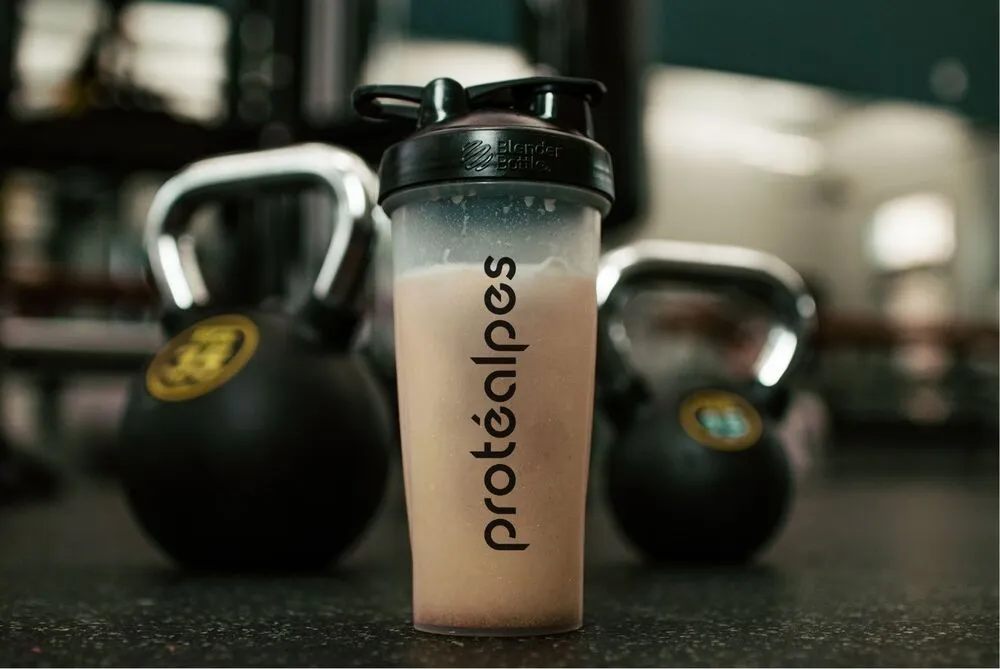
Whey protein is an essential complement to bodybuilding training. But it also serves many other sporting purposes. What is the ideal whey-water or whey-milk dosage to meet the needs of your profile?
It all depends on your tastes and the total amount of protein you need to ingest each day. Whey is the dietary supplement of choice for many athletes. Whether you're a body-builder, an endurance athlete or someone with an ectomorphic profile, whey powder can be used to boost your daily protein intake.
Despite its widespread use, dosing whey remains a poorly understood subject. The mix needs an optimal dosage of water or milk. This is what promotes the proper assimilation of this protein with its many essential amino acids.
Here's how to adjust your whey intake to benefit from its effects.
In a nutshell
- The whey-water ratio depends on individual needs and tastes. The more water, the lighter the texture. The less water, the smoother the shaker.
- Whey is ideal for body-builders, endurance athletes and ectomorphs. Anyone looking to increase their daily protein intake.
- The right dose of whey improves the assimilation of essential amino acids, promotes muscle recovery and builds lean body mass.
- The choice between whey-water or whey-milk influences digestion and calories. Water facilitates rapid assimilation, while milk provides more energy and creaminess.
- The right dose of whey ensures that you get the most out of your protein supplement. To do this, adjust the quantity according to your weight, activity and objectives.
Contents
- Should whey be prepared with water or milk?
- Dosing whey with water
- Choosing a whey-milk dosage
- Dosing whey with plant milk
- Choosing the right whey-water or milk dosage

Whey protein: the right amount of water
How much liquid should I use to prepare my whey?
Each scoop of protein in ml varies depending on the brand. Theamount of liquidto add to prepare your whey shake therefore varies. Here is a calculator to find out how much water you need for 30 g of whey:
In general, one dose of whey is mixed with 150 to 250 ml of liquid. However, this ratio varies according to the desired consistency of the shaker:
- thicker shakers use less liquid.
- those who prefer a lighter shaker use more liquid.
Using milk to mix whey makes the protein drink thicker than whey and water.
You can also use a milk base to add thickness and combine it with plenty of water. This has the advantage of making a creamier mixture without adding too many calories.
Whey water dosage: how to prepare your protein?
Nothing could be simpler.
Here's how to prepare an optimal water-whey mix:
- Step 1: Calculate the water dosage for a scoop of whey.
- Step 2: fill your shaker with the desired liquid (water or milk) at the desired temperature.
- Step 3: Add your dose of whey powder.
- Step 4: Shake the shaker until smooth.
Enjoy your meal!

Should whey be prepared with water or milk?
Turning a scoop of protein into ml: water or milk?
Whey protein users want to know whether whey can be dosed with milk. The question is important, because the liquid changes:
- TASTE;
- texture ;
- the shaker's caloric and nutritional content.
The dosage of whey with milk is the same as that with water. The choice of whey-water or whey-milk dosage therefore depends on your objectives: mass gain, maintenance, muscle leaning...
Dosing whey with water
Water is naturally the lowest-calorie option.
Awhey shaker mixed withwater will provide the calories present in the dose of whey used. And nothing more.
This whey and water mixture makes for alightand smoothdrink. It is an ideal mixture for athletes lookingto rehydrateafter exercise.
Another advantage of this option is that it iseconomical, as it does not require the purchase of milk (plant-based or animal-based). However, with whey that contains no additives or sweeteners, the mixture will naturally be very light and watery, unlike sweetened whey that contains thickeners.
Choosing a whey-milk dosage
Milk, on the other hand, provides additional calories. This source of proteins, vitamins and minerals is useful for those seeking to increase their nutritional intake.
The type of milk therefore becomes a criterion of choice. If you're looking to boost your calorie intake as part of a weight gain program, whole milk is the best choice.
Need a clearer idea of the calorie and protein content of different types of milk? Here's a summary table of the most common cow's milks:
| Cow's milk | Ideal for | Calories (kcal per 100 g) | Protein (g) | Carbohydrates (g) | Fat (g) |
|---|---|---|---|---|---|
| Whole cow | weight gain | 98 | 4,8 | 7,4 | 5,2 |
| Semi-skimmed cow | maintenance | 70 | 4,8 | 7,1 | 2,4 |
| Skimmed cow | the dry | 51 | 5,0 | 7,5 | 0,2 |
Dosing whey with plant milk
Some athletes only consume plant-based milk. This is an interesting option, but given thewide varietyofplant-based milks available, the choice is not easy.
Here is a summary of the calorie content and macronutrients found in eight different types of milk. The values correspond to 150 ml of drink, the recommended dose for a 30-gram whey shake with no added sugar:
| Milk / Vegetable milk | Calories | Protein (g) | Carbohydrates (g) | Fat (g) |
|---|---|---|---|---|
| Cow | 64 | 3,3 | 4,7 | 3,6 |
| Goat | 67 | 3,3 | 4,5 | 4,1 |
| Ewes | 103 | 5,3 | 5,1 | 7,0 |
| Soybeans | 40 | 3,3 | 2,5 | 1,9 |
| Almond | 24 | 0,5 | 2,5 | 1,1 |
| Rice | 50 | 0,3 | 9,7 | 1,0 |
| Oats | 47 | 1 | 6,5 | 1,5 |
| Coconut water | 19 | 0,2 | 2,8 | 1,3 |
Choosing the right whey-water or milk dosage
Depending on your sporting goals, preferences and tastes, you can opt for a whey-water or whey-milk blend.
Here's the nutritional information you need to know about a 30 g (no added sugar range) or 40 g (classic range) Protéalpes whey shaker :
| Liquid | Calories (kcal) | Protein (g) | Carbohydrates (g) | Fat (g) | ||||
|---|---|---|---|---|---|---|---|---|
| Classic | Sugar-free | Classic | Sugar-free | Classic | Sugar-free | Classic | Sugar-free | |
| Water | 155 | 116 | 24.5 | 22.8 | 11.1 | 3.2 | 1.5 | 1.4 |
| Whole cow | 283 | 212 | 31.1 | 27.8 | 20.5 | 10.2 | 8.7 | 6.8 |
| Semi-skimmed cow | 249 | 186 | 31.1 | 27.8 | 20.7 | 10.4 | 4.7 | 3.8 |
| Skimmed cow | 225 | 168 | 31.3 | 27.9 | 21.1 | 10.7 | 1.9 | 1.7 |
| Goat | 289 | 216 | 31.1 | 27.8 | 20.1 | 9.9 | 9.7 | 7.5 |
| Ewes | 361 | 270 | 35.1 | 30.8 | 21.3 | 10.8 | 15.5 | 11.9 |
| Soybeans | 235 | 176 | 31.1 | 27.8 | 16.1 | 7.0 | 5.3 | 4.2 |
| Almond | 203 | 152 | 25.5 | 23.6 | 16.1 | 7.0 | 3.7 | 3.0 |
| Rice | 249 | 186 | 25.1 | 23.2 | 30.5 | 17.8 | 3.5 | 2.9 |
| Oats | 249 | 186 | 26.5 | 24.3 | 24.1 | 12.9 | 4.5 | 3.6 |
| Coconut water | 193 | 144 | 24.9 | 23.1 | 16.7 | 7.4 | 4.1 | 3.4 |
Our sugar-free whey range has the lowest calorie content. It's the one to choose for short, targeted periods, such as during a lean period.
All this information is needed to choose the right type of liquid to mix with your whey. The rest is a matter of taste!
From these tables, we can see that mixing whey with milk changes the nutritional values somewhat. However, here we take the example of a mixture in 100% milk (animal or vegetable).
One way of benefiting from the low calorie content of the no-sugar-added range, while still having a slightly more indulgent mix than water, is to add a base of organic oat milk and top up every 150 ml with water. Here are the total nutritional values obtained with this type of mix:
| Plant milk | Calories (kcal) | Protein (g) | Carbohydrates (g) | Fat (g) |
|---|---|---|---|---|
| Oats | 135 | 23,2 | 5,8 | 2,0 |
Dosing whey: hot or cold water?
Yes, you can consume whey with hot water or hot milk.
Selecting the right Whey
Many athletes are concerned about the way whey is cooked, fearing that the heat will denature the proteins it contains.
Heat-induced protein denaturation has little effect on nutritional value. This is because absorption takes place after the proteins have been reduced by saliva and gastric juices.
However, the type of whey consumed must be taken into account:
Some whey products contain additives and sweeteners. When exposed to heat, these can be transformed into potentially harmful compounds. This is the case with sucralose, for example.
In this case, we specifically recommend choosing an additive-free whey for this type of mix. You should also be careful not to heat the whey too intensely, and to stir the mixture thoroughly to avoid creating protein clumps in the mix.
Choose according to your objective
Whey is a convenient and easy-to-consume form of protein. It can be used as a snack or as a protein supplementbefore or after exercise. It is an effective wayto increase protein intakethroughout the day, which is beneficial for muscle building.
However, heating whey slows down its assimilation, which impacts on the timing of its consumption. Those who take it as part of their post-workout recovery want to take advantage of the potential metabolic window.
However, using whey in a shaker of water or hot milk remains a viable option. However, the type of powder used needs to be considered in advance. In this way, you can adjust your diet and sports program.
In the morning, as a snack or even at night, whey can be consumed at any time of day.
Dosing your whey: how much for your goals?
Adapting your consumption
Taking whey is a common practice among bodybuilding enthusiasts. However, it can be adapted to suit different profiles and sporting objectives:
- When building muscle mass, it supplementsprotein intake to support muscle growth.
- During weight loss, it helps preserve lean body mass.
- For profiles struggling to reach their daily protein portion , its concentration makes intake easier.
When to use your whey
The anabolic window principle is being questioned, even though some studies suggest that it does indeed exist. The key factor is not the time of consumption, but the total protein intake throughout the day¹.
It all depends on the routine:
- After training, to aid recovery if no meal is planned;
- In the morning, to break the overnight fast or complement a low-protein breakfast;
- As a snack, if meals are spaced out or in case of cravings during the day.
What about days off?
Muscle rebuilding happensoutside oftraining.
It is therefore necessary to maintain protein intake on rest days. This can be achieved through diet or a whey shake, without excess.
Whey dosage per day
The ideal dose depends on :
- sporting objective;
- the type of sport practised ;
- weight ;
- sex
- age ;
- level of physical activity.
The ISSN recommends an overall daily intake of between 1.4 and 2.0 g protein/kg body weight/day (g/kg/d)¹.
Whey powder supplements meals to achieve a total that's specific to each athlete. Care should be taken to vary the sources of protein-rich foods (eggs, legumes, meat, fish, etc.).
Conclusion
Proper whey consumption maximizes rapid protein assimilation and promotes muscle development. Depending on body weight, training intensity and lifestyle, the amount of whey to take varies. Recommendations range from 1.6 to 2.2 g of protein per kilo of body weight per day. The quantity depends on the objective (muscle mass gain, lean mass maintenance or lean body mass).
To prepare your shaker, mix your whey protein with water or milk, or a mixture of the two , as you prefer. A standard dose of whey corresponds to around 150 to 200 ml of liquid. Milk or vegetable drinks (almond milk, soy milk, etc.) offer a thicker texture. Conversely, cold water enables faster assimilation and a lighter shaker. Hot water or hot milk can alter product quality if they contain additives.
For a lump-free preparation, pour in the liquid before the powder. Then shake the shaker until a homogeneous consistency is obtained. The right dosage avoids any digestive risk and ensures that your protein needs are met.
Whey is a whey protein with a high content of essential amino acids. This pure protein powder is suitable forall sportsmen and women. If you want to optimize your performance and/or build muscle mass.
Test your knowledge!
With which liquid is it generally recommended to mix whey?
What is the main purpose of whey protein?
What is the advantage of mixing whey with water?
What is the recommended dosage to prepare one portion of whey?
What is one of the reasons why bodybuilders use whey?
Why do some people prefer to mix whey with milk?
Scientific references and sources
¹ International Society of Sports Nutrition Position Stand: protein and exercise - 2017 - Ralf Jäger et al.