





Pace and speed often cause confusion: a watch displays 5'30/km, a treadmill indicates 11 km/h... and the reference point quickly disappears.
However, these two figures express the same reality: the speed of movement.
Knowing how to convert between them in a matter of seconds makes it easier to plan sessions, read performances, and facilitate exchanges between runners.
Enter your pace
Time over standard distances
| Distance | Time |
|---|---|
| 1 km | 5 minutes |
| 5 miles | 25 minutes |
| 10 km | 50'00 |
| Half marathon | 1 hour 45 minutes and 29 seconds |
| marathon | 3 hours, 30 minutes, 58 seconds |
Enter your speed
Time over standard distances
| Distance | Time |
|---|---|
| 1 km | 5 minutes |
| 5 miles | 25 minutes |
| 10 km | 50'00 |
| Half marathon | 1 hour 45 minutes and 29 seconds |
| marathon | 3 hours, 30 minutes, 58 seconds |
Quick reference table
| Pace (/km) | Pace (per mile) | Speed (km/h) | Speed (mph) | 10 km | marathon |
|---|---|---|---|---|---|
| 3 min/km | 4'50/mile | 20.00 km/h | 12.43 miles per hour | 30 minutes | 2 hours, 6 minutes, 35 seconds |
| 3'30/km | 5'38/mile | 17.14 km/h | 10.65 mph | 35:00 | 2 hours 27 minutes 41 seconds |
| 4 min/km | 6'26/mile | 15.00 miles per hour | 9.32 km/h | 40 min | 2 hours, 48 minutes, 47 seconds |
| 4'30/km | 7'14/mile | 13.33 km/h | 8.28 km/h | 45:00 | 3:09:53 |
| 5 min/km | 8:03/mile | 12.00 km/h | 7.46 km/h | 50'00 | 3 hours, 30 minutes, 58 seconds |
| 5'30/km | 8'51/mile | 10.91 miles per hour | 6.78 km/h | 55:00 | 3 hours, 52 minutes and 4 seconds |
| 6 min/km | 9'39/mile | 10.00 miles per hour | 6.21 miles per hour | 1 hour | 4 hours, 13 minutes, 10 seconds |
| 6 min 30 sec/km | 10'28/mile | 9.23 miles per hour | 5.73 km/h | 1 hour 5 minutes | 4 hours, 34 minutes, 16 seconds |
| 7 min/km | 11'16/mile | 8.57 miles per hour | 5.33 miles per hour | 1 hour 10 minutes | 4 hours, 55 minutes, 22 seconds |
Conversion formula:speed (km/h) = 60 ÷ Pace (min/km). To convert to miles: 1 mile = 1.60934 km.
Kilometers vs. Miles:The United States and the United Kingdom mainly use the imperial system (miles). A pace of 5:00/km is equivalent to approximately 8:03/mile.
Use pace for your training and races, and speed to compare with other sports or for treadmill settings.
Distinguishing between pace and speed remains a common difficulty for novice runners.
However, these two units of measurement reflect the same phenomenon: the pace at which you are progressing.
Understanding their connection and easily converting them helps you organize your training sessions, evaluate your results, and communicate clearly with your running partners.
Pace and speed: two expressions of the same data
Pace quantifies the time required to cover a certain distance, commonly measured in minutes per kilometer (min/km) or minutes per mile (min/mile).
Displaying 5:00/km indicates that you are covering each kilometer in 5 minutes. Speed, on the other hand, quantifies the distance traveled during a defined period of time, typically in kilometers per hour (km/h) or miles per hour (mph).
These two parameters work in inverse proportion: when your pace slows down (lower number), your speed increases proportionally. Running at 5:00/km is exactly the same as running at 12 km/h.
The conversion calculation is based on this equation: speed (km/h) = 60 ÷ pace (min/km).
For the reverse operation: pace (min/km) = 60 ÷ Speed (km/h).
Conversion table Pace ⇄ Speed
| Level | Pace (/km) | Speed (km/h) | 5 miles | 10 km | Half marathon (21.1 km) | Marathon (42.2 km) |
|---|---|---|---|---|---|---|
| Elite | 3 min/km | 20.00 km/h | 15:00 | 30 minutes | 1 hour 3 minutes 18 seconds | 2 hours, 6 minutes, 35 seconds |
| Elite | 3'10/km | 18.95 km/h | 15:50 | 31'40 | 1 hour 6 minutes 52 seconds | 2 hours 13 minutes 52 seconds |
| Elite | 3'20/km | 18.00 km/h | 16:40 | 33'20 | 1 hour 10 minutes and 25 seconds | 2 hours 21 minutes 10 seconds |
| Expert | 3'30/km | 17.14 km/h | 5:30 p.m. | 35:00 | 1 hour 13 minutes 51 seconds | 2 hours 27 minutes 41 seconds |
| Expert | 3'40/km | 10.4 mph | 18:20 | 36'40 | 1 hour 17 minutes and 24 seconds | 2 hours, 34 minutes, 28 seconds |
| Expert | 3'50/km | 15.65 miles per hour | 19:10 | 38'20 | 1 hour 20 minutes and 57 seconds | 2 hours, 41 minutes and 15 seconds |
| Confirmed+ | 4 min/km | 15.00 miles per hour | 20 minutes | 40 min | 1 hour 24 minutes 23 seconds | 2 hours, 48 minutes, 47 seconds |
| Confirmed+ | 4'10/km | 14.40 miles per hour | 20:50 | 41'40 | 1 hour 27 minutes 57 seconds | 2 hours 55 minutes 34 seconds |
| Confirmed | 4'20/km | 13.85 km/h | 21:40 | 43'20 | 1 hour 31 minutes 31 seconds | 3 hours, 3 minutes, 2 seconds |
| Confirmed | 4'30/km | 13.33 km/h | 22:30 | 45:00 | 1 hour 34 minutes 56 seconds | 3:09:53 |
| Confirmed | 4'40/km | 12.86 miles per hour | 23:20 | 46'40 | 1 hour 38 minutes 30 seconds | 3 hours 17 minutes |
| Intermediate+ | 4'50/km | 12.41 miles per hour | 24'10 | 48'20 | 1 hour 42 minutes and 4 seconds | 3 hours, 24 minutes, 8 seconds |
| Intermediate+ | 5 min/km | 12.00 km/h | 25 minutes | 50'00 | 1 hour 45 minutes and 29 seconds | 3 hours, 30 minutes, 58 seconds |
| Intermediate | 5'10/km | 11.61 miles per hour | 25 min 50 sec | 51'40 | 1 hour 49 minutes and 3 seconds | 3 hours, 38 minutes, 6 seconds |
| Intermediate | 5 min 20 sec/km | 11.25 km/h | 26'40 | 53'20 | 1 hour 52 minutes 29 seconds | 3 hours, 44 minutes, 57 seconds |
| Intermediate | 5'30/km | 10.91 miles per hour | 27'30 | 55:00 | 1 hour 56 minutes and 2 seconds | 3 hours, 52 minutes and 4 seconds |
| Intermediate | 5'40/km | 10.59 miles per hour | 28'20 | 56:40 | 1 hour 59 minutes and 36 seconds | 3 hours, 59 minutes, 12 seconds |
| Beginner+ | 5'50/km | 10.29 miles per hour | 29'10 | 58:20 | 2 hours, 3 minutes, 10 seconds | 4 hours, 6 minutes, 19 seconds |
| Beginner+ | 6 min/km | 10.00 miles per hour | 30 minutes | 1 hour | 2 hours, 6 minutes, 35 seconds | 4 hours, 13 minutes, 10 seconds |
| Beginner+ | 6 min/km | 9.73 miles per hour | 30'50 | 1 hour 1 minute 40 seconds | 2 hours 10 minutes and 9 seconds | 4 hours, 20 minutes and 17 seconds |
| Beginner | 6 min 20 sec/km | 9.47 miles per hour | 31'40 | 1 hour 3 minutes 20 seconds | 2 hours 13 minutes and 43 seconds | 4 hours, 27 minutes, 25 seconds |
| Beginner | 6 min 30 sec/km | 9.23 miles per hour | 32'30 | 1 hour 5 minutes | 2 hours 17 minutes and 7 seconds | 4 hours, 34 minutes, 16 seconds |
| Beginner | 6 min 40 sec/km | 9.00 km/h | 33'20 | 1 hour 6 minutes 40 seconds | 2 hours 20 minutes 41 seconds | 4 hours, 41 minutes, 23 seconds |
| Beginner | 6 min 50 sec/km | 8.78 miles per hour | 34'10 | 1 hour 8 minutes 20 seconds | 2 hours, 24 minutes, 15 seconds | 4 hours, 48 minutes, 31 seconds |
| Beginner | 7 min/km | 8.57 miles per hour | 35:00 | 1 hour 10 minutes | 2 hours, 27 minutes, 40 seconds | 4 hours, 55 minutes, 22 seconds |
| Beginner | 7 min/km | 8.37 miles per hour | 35 min 50 sec | 1 hour 11 minutes and 40 seconds | 2 hours, 31 minutes, 14 seconds | 5:02:29 |
| Beginner | 7 min/km | 8.18 miles per hour | 36'40 | 1 hour 13 minutes 20 seconds | 2 hours, 34 minutes, 48 seconds | 5:09:37 |
| Beginner | 7 min 30 sec/km | 8.00 km/h | 37:30 | 1 hour 15 minutes | 2 hours, 38 minutes, 13 seconds | 5 hours, 16 minutes, 27 seconds |
| Beginner | 7'40/km | 7.83 miles per hour | 38'20 | 1 hour 16 minutes and 40 seconds | 2 hours 41 minutes and 47 seconds | 5 hours, 23 minutes, 35 seconds |
| Beginner | 7.50/km | 7.66 miles per hour | 39'10 | 1 hour 18 minutes 20 seconds | 2 hours, 45 minutes, 21 seconds | 5 hours, 30 minutes, 42 seconds |
To supplement this data, the Protéalpes pace calculator allows you to calculate a pace based on a distance and a reference point.
Why do runners prefer pace?
Pace dominates as the preferred metric in the world of running for practical reasons.
It makes mental calculations easy during activity: by maintaining a pace of 5'00/km, you can easily deduce that 10 km will take 50 minutes, while 21 km will take 1 hour 45 minutes. This arithmetic facility optimizes your pace control and helps you predict your split times.
Pace also more accurately reflects how your body feels. The difference between 5:00/km and 4:30/km produces a distinctly different sensation during exercise, unlike the difference between 12 km/h and 13.3 km/h, which remains more abstract.
The training programs and discussions between athletes are based exclusively on pace: "intervals at 4'00/km," "long runs at 5'30/km."
The imperial system: miles and mph
Athletes from English-speaking countries, especially the US and UK, use the imperial system based on the mile. This unit is equal to 1.60934 kilometers. This alternative system sometimes causes misunderstandings during world competitions or when analyzing international stopwatches.
Converting 5:00/km gives 8:03/mile. This substantial variation shows that a pace that seems moderate in min/mile is actually equivalent to a fast tempo. Current GPS devices usually offer the option to switch between these two references, but understanding the conversion intuitively is still useful.
Competition formats also vary: while Europeans organize 5 km, 10 km, and half marathons, Americans include 5 miles (8 km) and 10 miles (16 km) races, and regularly use the mile as a standard. The marathon maintains its global length of 42.195 km (26.219 miles).
Speed: when should it be used?
Although pace is the predominant measure, speed remains appropriate for certain uses. Indoor running machines generally display speed in km/h or mph, requiring you to recalculate to identify your usual pace.
Comparisons with other endurance disciplines (cycling, swimming) are made more intuitively via speed.
Scientific studies and physiological assessments also use speed, particularly to determine VMA (Maximum Aerobic Speed). Tests carried out in specialized centers and training methods based on MAS are expressed in km/h.
An athlete with a MAS of 18 km/h can maintain this pace (corresponding to 3'20/km) for approximately 6 minutes.
Essential formulas and practical exercises
Once understood, these simple formulas quickly become training reflexes. They work for all distances and all levels, from beginners to experienced runners. Using them regularly allows you to master them naturally and adjust your sessions instinctively.
1. Pace calculation (min/km)
Pace = Total time (min) ÷ Distance (km)
Decimal conversion → seconds: multiply by 60
Example: 52.5 min for 10 km = 52.5 ÷ 10 = 5.25 min/km → 5'15/km
2. Estimated running time
Time (min) = Pace (min/km) × Distance (km)
Example: 5.75 min/km × 18 km = 103.5 min → 1h43’30
3. Calculating target pace for a goal
Required pace = Target time (min) ÷ Distance (km)
Example: Half marathon in 2 hours → 120 min ÷ 21.1 km = 5.687 min/km → 5'41/km
4. Conversion of speed → pace
Pace (min/km) = 60 ÷ Speed (km/h)
Example: 11.5 km/h → 60 ÷ 11.5 = 5.217 min/km → 5'13/km
5. Conversion of pace → speed
Speed (km/h) = 60 ÷ Pace (min/km)
Example: 4.333 min/km → 60 ÷ 4.333 = 13.85 km/h
Recommended paces by level and distance
Setting the pace to maintain according to your level and the distance covered is the basis for successful preparation. Running too fast will exhaust your reserves prematurely, while running too slowly will limit your progress.
Beginners (less than 6 months of practice)
Profile: You are new to running, and your priority is to build your basic endurance and maintain a regular training schedule.
| Distance | Average speed | Speed (km/h) | Time objective |
|---|---|---|---|
| 5 miles | 6'30 – 7'30/km | 8.0–9.2 km/h | 32:30 – 37:30 |
| 10 km | 6:45–7:45/km | 7.7–8.9 km/h | 1:07–1:17 |
| Half marathon | 7:00–8:00/km | 7.5–8.6 km/h | 2:28 a.m. – 2:49 a.m. |
| marathon | Not recommended for beginners | - | - |
Main training zone: 70-75% of maximum heart rate
At this stage, focus on consistency. Your training plan should include a maximum of three sessions per week, mainly focusing on basic endurance. Speed is less important than how you feel: you should be able to hold a conversation while exercising.
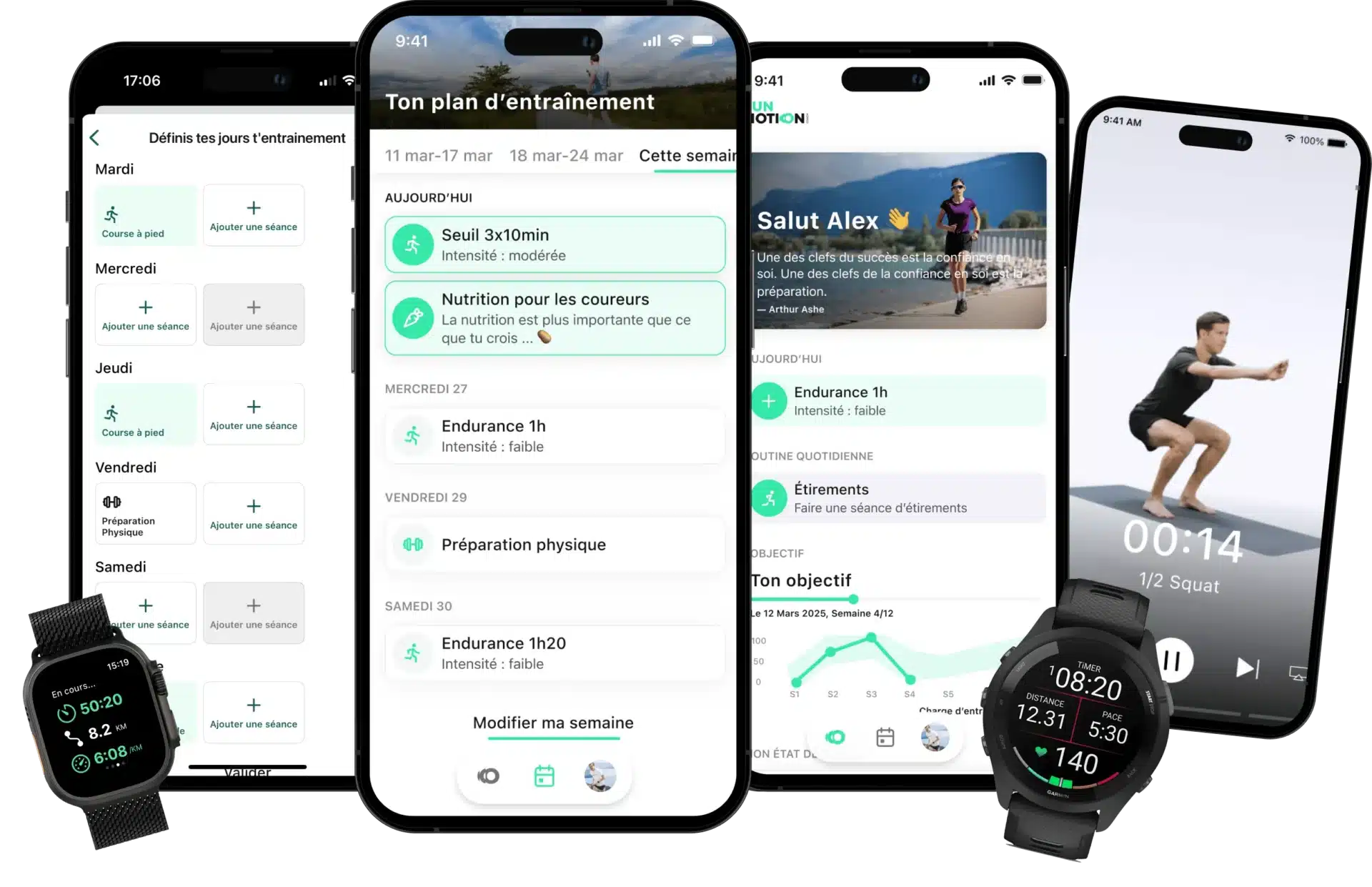
At this stage, starting with a coaching app such as RunMotion Coach will be particularly useful for quantifying mechanical load and avoiding injuries.
Intermediate (6 months to 2 years of practice)
Profile: You run regularly, have already completed several races, and are looking to improve your times. Your training includes a variety of sessions.
| Distance | Average speed | Speed (km/h) | Time objective |
|---|---|---|---|
| 5 miles | 5:00–6:00/km | 10.0–12.0 km/h | 25:00 – 30:00 |
| 10 km | 5'15–6'15/km | 9.6–11.4 km/h | 52 minutes 30 seconds – 1 hour 2 minutes 30 seconds |
| Half marathon | 5'30–6'30/km | 9.2–10.9 km/h | 1:56 a.m. – 2:17 a.m. |
| marathon | 6:00–7:00/km | 8.6–10.0 km/h | 4:13 a.m. – 4:55 a.m. |
Training zone: 75-85% HRmax (endurance) + sessions at 85-90% (threshold)
Your training combines long runs, threshold sessions, and short intervals. Using a time calculator helps you plan your split times and track your progress week after week.
Experienced (more than 2 years of practice)
Profile: You have mastered the different running speeds, follow a structured plan, and aim for ambitious time goals. Your maximum running speed is known and guides your preparation.
| Distance | Average speed | Speed (km/h) | Time objective |
|---|---|---|---|
| 5 miles | 4:00–4:45/km | 12.6–15.0 km/h | 8:00 p.m. – 11:45 p.m. |
| 10 km | 4'15 – 5'00/km | 12.0–14.1 km/h | 42:30 – 50:00 |
| Half marathon | 4'30–5'15/km | 11.4–13.3 km/h | 1:35–1:51 |
| marathon | 4:45–5:45/km | 10.4–12.6 km/h | 3:20 a.m. – 4:02 a.m. |
Training zone: complete control of zones (60-95% HRmax depending on session)
Your plan includes specific marathon or half marathon sessions, hill work, and long interval training. Automatic calculation of your pace based on your VMA optimizes each session.
Recovery and nutrition
Protein after exercise
Running places intense demands on muscle fibers, particularly during interval training or long runs. Proteins play a role in repairing and strengthening muscle tissue damaged during exercise.
Athletes should aim for 0.25 to 0.40 g of protein per kg of body weight within 2 hours of training. That's about 20 to 30 g of protein for a 70 kg runner.
Good sources include eggs, chicken, fish, dairy products, or whey protein for rapid post-workout absorption.
Whey protein with whole cane sugar
Formula developed by qualified pharmacists 🔬
- Manufactured in-house by Protéalpes
- No additives, no sweeteners
- Protein isolate from Rhône-Alpes
Also available in packs of 3 to 4.5 kg

Carbohydrates
Carbohydrates replenish muscle glycogen stores depleted during running, particularly after efforts lasting longer than 60 minutes or at high intensity.
- Before exercise: focus on complex carbohydrates 2-3 hours beforehand (pasta, rice, oatmeal).
- During exercise (> 90 min): 30-60 g of carbohydrates per hour in the form of gels, energy drinks, or dried fruit
- After exercise: combine carbohydrates and proteins in a ratio of 3:1 or 4:1 to optimize recovery.
Endurance drink
- Performance during exercise
- 40 to 60 g of carbohydrates/hour
- Gluten-free
Hydration and active recovery
Beyond macronutrients,hydration remains a key part of recovery. Replenishing fluid losses (approximately 0.5 to 1 liter per hour of exercise) helps restore physiological functions and prevent cramps.
Active recovery (light jogging at 60-65% MHR) facilitates the elimination of metabolic waste and prepares the body for future training sessions.