




A weight gainer is a strategic choice for anyone who struggles to gain muscle mass. This blend of protein and complex carbohydrates comes in various forms. Its purpose is to create a controlled calorie surplus to support recovery and muscle growth.
Lean, hard, weight gainer— these terms refer to different formulations, and it can be hard to know which one to choose. Between marketing hype and nutritional quality, how do you choose the best weight gainer?
Before analyzing enriched formulas and checking product ingredients, the question is: how many extra calories does the body need to support muscle growth? And depending on your level (beginner or advanced) and body type (naturally lean or prone to gaining weight), the choice will vary.
Should you opt for a high-carb mass gainer? A purer whey protein? Or a lean formula to limit fat gain?
Ratio, composition, and digestibility: these are the key factors to consider when choosing the right dietary supplement, ensuring that it is used properly and effectively.
In a nutshell
- Composed of protein and calories from carbohydrates and/or fats, a weight gainer is a high-calorie supplement designed toincrease daily caloric intake andsupportmusclebuilding.
- Theprotein-to-carbohydrate ratiois the key factor: a high-carbohydrate weight gainer promotes muscle mass gain, while a standard whey protein focuses on muscle repair and adaptation while minimizing excess fat gain.
- Thequality of ingredientsaffects digestion, recovery, and fat storage.
- The choice depends onthe athlete, theirmetabolism, andtheir goals.
- Effective weight gain relies on a gradual increase in calorie intake (300 to 500 kcal per day).
Contents
- What is the purpose of a weight gainer?
- Why is a weight gainer useful, and when isn't it?
- Weight Gain from a Scientific Perspective
What is the purpose of a weight gainer?
Composition, ingredients: What is a weight gainer?
A weight gainer is a high-calorie dietary supplement that often consists of a blend of proteins and carbohydrates. Some formulations may also contain a certain amount of fat.
Its role is to provide a concentrated source of energy in addition to protein to optimize muscle growth. This extra energy is essential for muscle building and recovery.
While whey protein may be sufficient for some people,mass gainers provide additional carbohydrates to create what is known as a caloric surplus.
| Product | Mass Protéalpes Weight Gainer | Protéalpes Whey Protein (Classic Line) |
| Composition | carbohydrates: 70 g ; protein: 23 g | carbohydrates: 11 g ; protein: 23 g |
| Nutritional Value | between 382 and 385 calories per serving | between 152 and 157 kcal |
| Objective | Muscle mass development | Optimizing Muscle Recovery |
Why is a weight gainer useful, and when isn't it?
A weight gainer is useful if a person:
- has a fast metabolism that burns a lot of calories;
- is unable to meet their daily calorie goals through diet;
- loss of appetite;
- trains at a high volume.
Conversely, there are situations in which weight gainers are of little or no benefit, such as for sedentary individuals. They are also unnecessary if there is already a calorie surplus.
Weight Gain from a Scientific Perspective
Sports nutrition plays a key role in muscle building and recovery. There is no shortage of scientific literature on the subject. The golden rule remains:gradual progression. When it comes to gaining muscle mass, we’re talking about a moderate caloric surplus of 300 to 500 kcal per day.
Next, it’s important to note that a protein intake of 1.4 to 2.0 grams per kilogram of body weight per day is generally considered effective for improving the muscle’s adaptive response to exercise¹ (adjusted according to the type of activity). However, for muscle development, athletes can aim for a range of1.6 to 2.2 g/kg/day, particularly those who train intensively².
Finally, it’s important to keep in mindthe importance of muscle stimulation. Without physical exercise tailored to building muscle mass, a weight gainer is useless—it will only lead to fat gain, which is generally not the intended goal.
The 4 criteria for choosing the best weight gainer
The protein-to-carbohydrate ratio
The protein-to-carbohydrate ratio is the key metric to focus on. These two ingredients are the core components of weight gainers, which are primarily available under three names:
- hard gainer;
- lean gainer;
- mass or weight gainer.
Whenchoosing between hard gainers, lean gainers, or weight gainers, it’s important to understand that these terms refer to different nutrient ratios. Hard gainers are often marketed as having a higher carbohydrate content to help ectomorphs gain weight. Lean gainers, on the other hand, are presented as more balanced options, theoretically designed for lean muscle gain.
In reality, there is no scientific basis or standard that dictates specific ratios for these products.
That said, "mass gainer" or "weight gainer" is a general term referring to a product with a very balanced ratio of protein to carbohydrates, making it ideal for sustainable muscle gain.
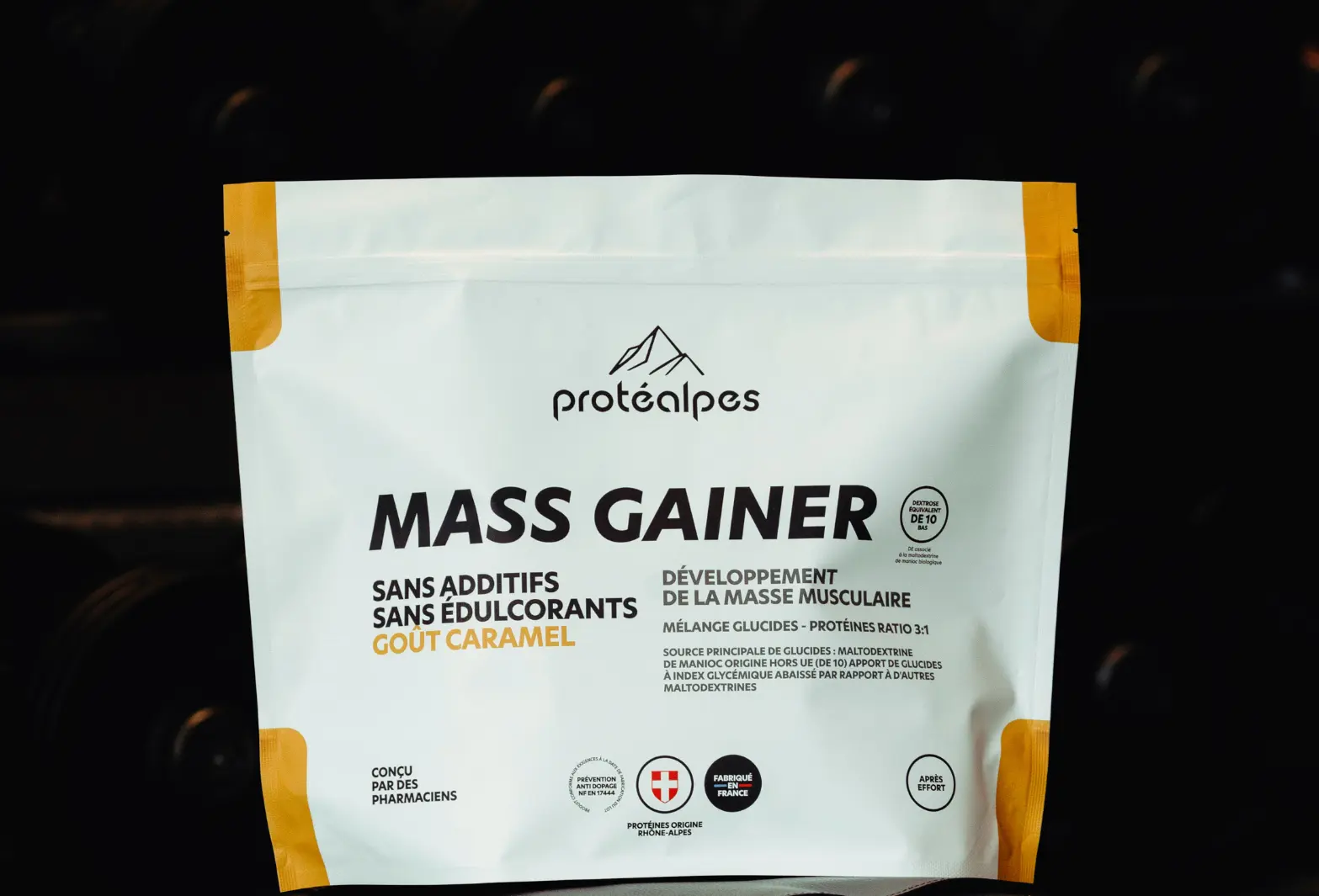
With 70 g of carbohydrates and 23 g of protein, the Protéalpes weight gainer has a carbohydrate-to-protein ratio of 3 to 1.
The quality of carbohydrates to watch out for
Beyond the ratio, we closely examine the ingredients to ensure we choose the right weight gainer.
There are many forms of carbohydrates. Maltodextrin is usedfor its neutral taste, controlled absorption, and easy digestibility. It releases a high amount of carbohydrates before, during, or after exercise, which is also beneficial for endurance sports.
Some manufacturers use solvents in the production of maltodextrin, which degrades it. For high-quality carbohydrates, opt for the organic version, which meets stricter standards.
There are also other formulations based on complex carbohydrates, such as oatmeal. It is rich in fiber and carbohydrates that are released slowly, which helps stabilize blood sugar levels. It also provides a significant amount of fat to maximize the calorie content per unit of weight.
One of the challenges of formulation is to avoid induced insulin spikes and the fat storage that can result from them.
Protein quality: whey isolate or concentrate?
Just as with carbohydrates, another factor to consider is the source of protein, which is responsible for building muscle fibers.
Here, it is the BCAA content—particularly leucine—that interests us, as well as the low lactose content.
Servings of protein powderideally contain between 700 and 3,000 mg of leucine and a balanced supply of essential amino acids (EAAs)¹.
Voilà pourquoi la whey isolate arrive en tête. L’isolat de protéines de lactosérum permet une absorption rapide, tout en étant pauvre en lipides et très faible en lactose (<3 %). C’est d’ailleurs une option qui convient aux personnes intolérantes.
The list of ingredients and transparency
The shorter the ingredient list and the more natural the ingredients, the better.
The main goal isto avoid sweeteners and additives that have no nutritional value other than altering the taste or texture of the final product. This includes artificial sweeteners such assucralose, thickeners, emulsifiers, and artificial colors.
Not only are they useless, but they can also be dangerous. Some can disrupt metabolism or, in some cases, cause digestive problems.
We therefore prefer a brand whose traceability and transparency ensure thatthe productis made in Europe andis free of sucraloseand other additives.

Mass gainer
- High in protein, no additives, gluten-free
- Organic cassava maltodextrin
- Doping substance-free
- Carbohydrate:protein ratio 3:1
Choose a weight gainer based on your athletic profile
Choosing the right weight gainer requires understanding the nutritional needs involved in gaining weight.
For those who struggle to gain weight or have a fast metabolism
"Hard gainer" literally means someone who has a hard time gaining weight. This term refers toectomorphs—people who are naturallyslim and lean —whose metabolism is fast, meaning they burn calories easily.
This body type makes it harder to gain weight and build muscle. That’s why they have a higher calorie requirement, and this is where a high-calorie weight gainer can help. The best choice is a weight gainer that is high in carbohydrates but low in dextrose equivalent (DE).
For so-called mesomorph body types
For people who are already muscular and want to gain muscle mass while limiting fat gain, it’s especially important to incorporate a weight gainer into their diet effectively.
The goal is to create a controlled caloric surplus, without excess that could be counterproductive. The question of whether to choosea mass gainer or whey protein may even arise.
For endomorph body types
These individuals should monitor their food intake to avoid gaining fat, which they tend to store easily.
Additionally, weight gainers are not the most suitable products for building muscle mass. Instead, we recommend opting for whey supplements, which provide a good amount ofprotein in powder formwhile keeping calorie intake limited.
How can you use a weight gainer without gaining too much fat?
When should you take your weight or mass gainer?
There are threeideal times to takeyour weight gainer:
- after a weight-training session or an intense workout, to take advantage ofany potential anabolic window and to recharge your energy;
- as a snack between meals (mid-morning or mid-afternoon), to maintain adequate protein levels;
- within an hour before bedtime, depending on the individual, as the weight gainer does not interfere with sleep.
When it comes to choosing the right time for a snack, this will depend on the athlete’s training schedule and goals. However, it’s not necessarily a good idea to eat one before a meal, as this could leave you feeling full before mealtime.
It’s important to remember that, beyond timing, it’s the total daily amount that matters most. Building muscle requires a consistent and sufficient intake of protein and calories throughout the day.
How do you prepare your shaker?
First, you need to adjust the serving size. To prepare a Protéalpes mass gainer, we recommend 2 x 50 g of powder—or 2 scoops—to be mixed with 400 to 500 ml of water, preferably cold. This is because the temperature of the liquid affects how well the powder dissolves, and cold water works best.
Like anydietand exerciseprogram, it must be tailored to the individual. Therefore, it is important to monitor your weight on the scale in order to adjust the portion sizes to meet your specific needs.
Can you combine creatine and a weight gainer?
Absolutely! Combining the two is actually beneficial for muscle growth and strength gains. Creatine benefits from insulin’s effects, which are linked to carbohydrate intake.
Creatine will enable athletes to perform a series of intense exercises and provide them with the energy and muscular support needed to sustain that intensity.
Is a weight gainer always the best solution?
Industrial air duct vs. optimized "homemade" air duct
It’s tempting to compare the two by contrasting the “good” gainer with the “bad” one, but:
- An industrial sleeve can be of good or poor quality
Some brands hide the source of the carbohydrates, which affects the weight gainer’s effectiveness, since they make up a large portion of its composition. Some weight gainers containadditives and may even be contaminated with performance-enhancing substances due to shared production lines with other products.
In contrast, other brands, such as Protéalpes, prioritize transparency and offer high-quality weight gainers.
However, their price remains relatively high given their ingredients. As a result, homemade alternatives can be a good option.
- A homemade weight gainer is worth trying if it's well-rounded
A weight gainer can be made at home, but the only real risk is that it may be nutritionally incomplete and therefore ineffective.A weight gainer recipemade with oatmeal, whey isolate, and almond butter has the advantageofbeing nutritionally complete and less expensive.
However, this type of mass gainer has its limitations in terms of practicality, storage, and portability. Powdered mass gainers are therefore easier to prepare and carry.
Whey or mass gainer: which one should you choose?
The main difference between the two is the calorie content.
Whey protein is primarily made up of protein, with a small amount of carbohydrates. Weight gainers and mass gainers, on the other hand, contain protein and a large amount of carbohydrates to provide the desired calorie intake.
This difference has a significant impact on yourdaily calorie intake, which should be adjusted according to your needs.
You should also choose based on your body composition and desired results:
- for athletes looking to optimize their body composition → whey;
- to gain weight → gain weight;
- to increase protein intake without a significant increase in calories → whey;
- to support a high training volume while maximizing muscle mass → bulking.
Here is a comparison table:
| Criteria | Whey Protéalpes (Classic Line) | Protéalpes Mass Gainer |
|---|---|---|
| Ingredients | Whey protein isolate + cane sugar + natural flavoring + coconut flour | Whey protein isolate + cassava maltodextrin + cane sugar + natural flavoring + coconut flour |
| Calories | ≈ 152 to 157 calories per serving | ≈ 382 to 385 kcal per serving |
| Protein | ≈ 23 g per serving | ≈ 23 g per serving |
| including BCAAs | ≈ 5 to 6 g | ≈ 5 to 6 g per serving |
| Sources of protein | Whey protein isolate from pasture-raised milk | Whey protein isolate from pasture-raised milk |
| Carbohydrate sources | organic unrefined cane sugar + natural sugars | organic cassava maltodextrin (main source) + organic unrefined cane sugar + natural sugars |
| Protein-to-carbohydrate ratio | 2:1 (more protein than carbohydrates) | 1:3 (more carbohydrates than protein) |
| Objectives | – Promote muscle adaptation and recovery – Supplement the protein in your overall diet – Maintain muscle mass | – Promote a calorie surplus – Build muscle mass – Help people with fast metabolisms gain weight |
| Strengths | – High in high-quality protein – Supports muscle synthesis and recovery – Low in carbohydrates and fat | – Provides a high energy intake in a concentrated form – Formulated for muscle gain |
The main difference lies in the calorie content, which serves different purposes.
Conclusion
Choosing the right weight gainer for effective muscle gain isn’t just about randomly increasing your calorie intake. First and foremost, you need to assess your body type, your goals, and your diet to determine your actual calorie needs.
The quality of a weight gainer depends largely onthe source of its ingredients, its protein-to-carbohydrate ratio, and the absence of additives. A mass gainer contains carbohydrates and protein designed to promote a high caloric intake and support protein synthesis. Meanwhile, whey protein, which is rich in protein and easy to digest, is beneficial for building and maintaining muscle without adding body fat.
The best approach is to gradually increase your daily calorie intake,adjust your diet(to ensure it’s rich in minerals and vitamins), and avoid unnecessary fat intake. However, it’s important to remember that no supplement, no matter how fortified, can replace a high-quality, healthy, and varied diet. An appropriate exercise regimen is also another key element in successfully gaining muscle mass.