






Recommended fat intake calculator for athletes
Calculate your fat requirements based on your profile, with verification as a percentage of total calories.
Recommended daily fat intake:
As a percentage of total calories:
Lipid intake represents the amount of fat you consume each day through food.
Fats are a highly concentrated source of energy: 1 g of fat provides 9 kcal, which is more than twice as much as carbohydrates and proteins.
Fats are not just a source of energy; they are essential for hormone production, the absorption of certain vitamins (A, D, E, K), the proper functioning of the nervous system, and the health of cell membranes.
Fatty acids play a role in regulating blood sugar through their effects on insulin sensitivity, the overall glycemic index of the diet, and the composition of adipose tissue.
For athletes, sufficient intake of "good fats" is essential for both health (hormones, menstrual cycle, recovery) and medium/long-term performance.

How much fat per day? (amount of fat, total calorie intake)
The French Food Safety Agency (now ANSES) has published an opinion titled “Opinion of the French Food Safety Agency on the Update of Recommended Dietary Intakes for Fatty Acids” (Reference No. 2006-SA-0359).
For adults, ANSES recommends: total fat = 35 to 40% of total energy intake (TEI).
For a 2,000-calorie-per-day diet (a value commonly used in the agency’s guidelines), this amounts to approximately 78 to 90 grams of fat per day (daily fat intake).
The detailed nutritional guidelines for an adult consuming 2,000 kcal per day are:
- Total fat: 35–40% of total energy intake.
- Total saturated fatty acids (saturated fat): ≤ 12% of total energy intake, with the sum of lauric, myristic, and palmitic acids ≤ 8%.
- Linoleic acid (omega-6): 4% of EFA (essential polyunsaturated fatty acids).
- Alpha-linolenic acid (omega-3): 1% of the AET.
- EPA + DHA (long-chain omega-3 fatty acids): 500 mg/day, including 250 mg of DHA (docosahexaenoic acid).
- Oleic acid (omega-9, monounsaturated fat): 15–20% of total fatty acids.
L’apport en acides gras trans (gras trans) doit rester très bas :
– l’ANSES retient une limite de 2% de l’apport énergétique total
– l’OMS recommande < 1% de l’AET (≈ 2,2 g/j pour 2 000 kcal).
The recommended amount of fat willvary depending on:
- Body weight and lean body mass (an athlete aiming to gain muscle mass may consume more fat, while staying within the recommended ranges).
- Physical activity (higher energy needs, meaning more calories per day, which translates to more fat in absolute terms but not necessarily as a percentage).
- The overall diet (caloric intake, nutritional balance between fats and carbohydrates, glycemic index of the diet).
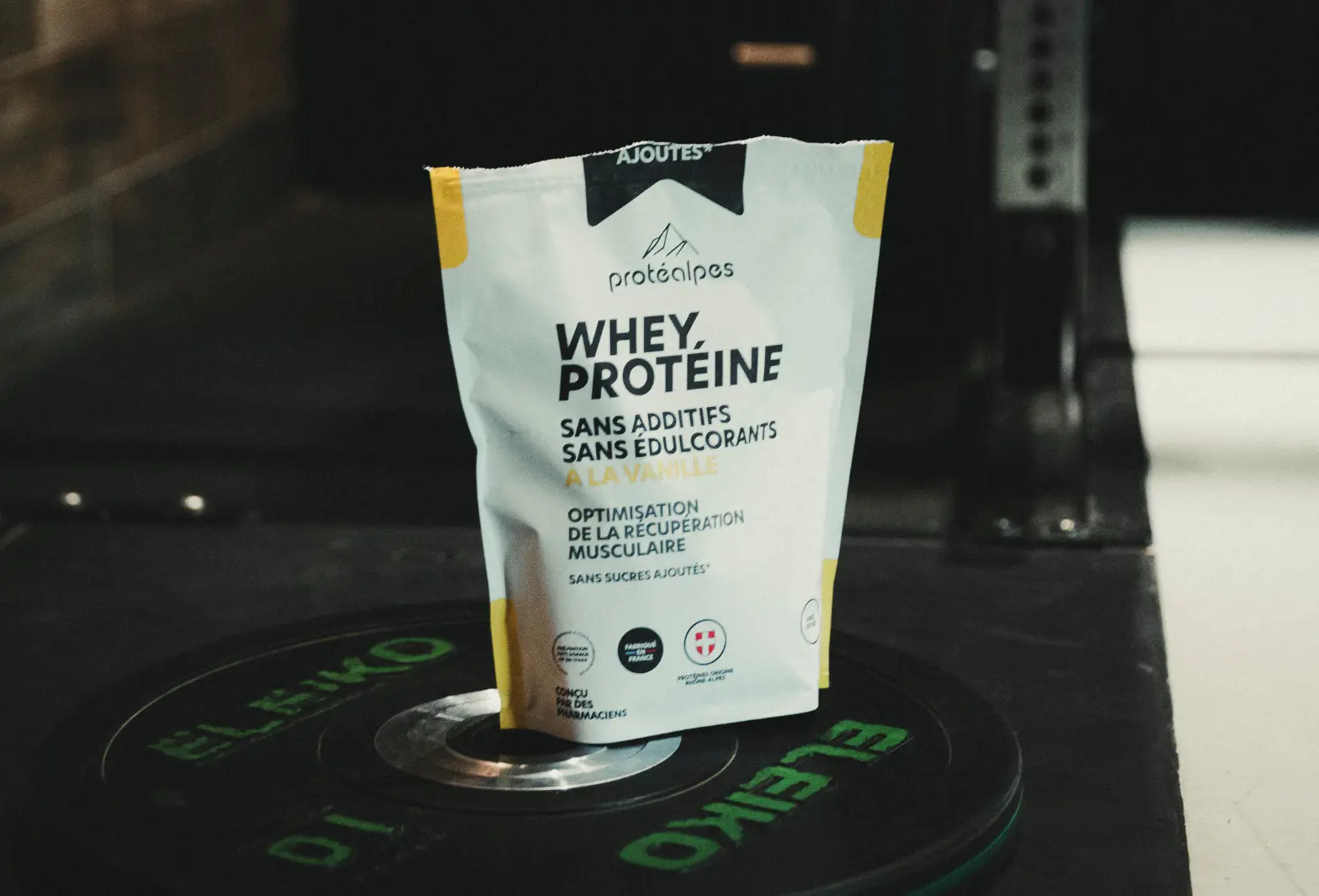
High-quality sugar-free proteins
- Cold microfiltration
- Optimal digestibility
- Unsweetened flavor
- Without performance-enhancing substances
- Gluten-free
Fat, weight gain, muscle gain, and obesity
Fats have a significant impact on weight because they are very energy-dense (9 kcal/g); a chronic excess of total calorie intake (fats + carbohydrates) is stored in adipose tissue and promotes weight gain, fat accumulation, and, ultimately, obesity.
Fats only “cause weight gain” if total calorie intake exceeds energy needs (a daily calorie surplus); the role of fats in weight gain therefore depends on the overall context, including carbohydrates, physical activity, and the body’s metabolism (energy expenditure).
When it comes to building muscle mass, the key is to ensure that you:
- A sufficient energy intake (a slight increase in daily calories).
- A moderate amount of fat (e.g., ~1 g/kg of body weight), accounting for 35–40% of total energy intake, with an emphasis on healthy fats.
To limit unwanted weight gain:
- Monitor total energy intake and track macronutrient distribution (macronutrient calculation).
- Choose the right fats (healthy fats) rather than cutting out all fats, as they play an important role in satiety, blood sugar control, and vitamin absorption.

Types of fats and choosing fats
What is this calculator used for?
The main purpose of the tool is to suggest a range of lipids suitable for athletes, expressed in grams per kilogram of body weight.
The idea is to find a balance: enough fat to ensure good health (hormones, vitamins, essential fatty acids), but not too much so as to leave enough room for carbohydrates, which remain the primary fuel for intense and repeated efforts, and proteins, which are essential for muscle mass.
The tool therefore does not seek to maximize fat intake, but rather to suggest a "reasonable" range that is compatible with a balanced sports diet.
Specifically, the calculator displays a range of daily fat intake based on body weight.
This range illustrates the zone in which most athletes will be able to meet their fat requirements while optimizing their carbohydrate and protein intake.
Finally, this tool also has an educational function. It reminds us that lipids should neither be demonized (diets too low in fat, with hormonal risks) nor overconsumed at the expense of other macronutrients, especially when the goals are performance, recovery, and good body composition management.
It serves as a practical benchmark to be integrated into a more comprehensive approach: calculating calorie requirements, protein/carbohydrate/fat distribution, and fine-tuning according to sport, training volume, and goals (fat loss, maintenance, weight gain).
Whey protein
- Manufactured in-house by Protéalpes
- No additives, no sweeteners
- Protein isolate from Rhône-Alpes

These professional clubs put their trust in us: