




Stereotypes still hold women backfrom gaining weight. Building muscle and consuming protein does not make you overly muscular. On the contrary, wantingto increase your muscle massis a great way to improve yourphysiquein a balanced way. And the reasons for doing so are not just aesthetic.
For women, gaining weight is about buildingmuscle. It is a misconception that hormones or testosterone prevent female muscles from developing. This is not true: with the right program, calorie intake, and training, the body can progress.
Depending on the type of weight gain program, it is even possible to limit fat gain. To achieve this, plan meals that are rich in protein, complex carbohydrates, and healthy fats. At the gym, target specific muscle groups in training sets. Focus on the glutes, but also include the back and shoulders, gradually increasing the weights. Add rest, recovery, and good sleep to facilitate muscle growth.
How does this differ from weight gain in men? How long does it take? When should you do your program? Here is all the advice you need to achieve thisfitness goal. Backed by scientific data, here's how to successfully gain weight as a woman.
In a nutshell
- Weight gain in women aims to increase muscle mass without excess fat. It is achieved through a balance of diet, training, and rest.
- Hormonal differences (testosterone, estrogen) do not prevent women from gaining muscle. Their gains are comparable to those of men, provided they follow a regular and well-structured training program.
- On the menu: a calorie surplus (+300-500 kcal/day) and an intake of 1.6 to 2 g of protein/kg/day. This is the combination that promotes muscle growth and limits fat gain.
- Regularity is more important than the menstrual cycle. The time of the month does not influence the results; only consistency matters.
- Whey protein, rich in BCAAs, supplements the diet for lean muscle gain and optimal muscle recovery.
Contents
- What is a weight gain program for women?
- What are the differences between weight gain in women and men?
- Does the menstrual cycle impact a woman's weight gain program?
- When should you consider gaining muscle mass?
- Bulking, cutting, and dieting: what's the difference?
What is a weight gain program for women?
What does weight gain mean for women?
Weight gain in women aims to increase muscle mass and improve body composition.
In weight training, this is a phase where the goal is to increase muscle volume. It is therefore not aboutgaining weight, but gainingmuscle massin the body.
The idea is to maintain or reduce fat mass, which requires a targeted approach. A weight training program for women to gain weight combines three elements:
- food;
- weighttraining;
- rest.
What are the differences between weight gain in women and men?
The differences between men and women are mainly physiological. They do not hinder the benefits of a weight gain program.
There are many differences between the two sexes: height, bone length, leverage. These parameters affect how movements are performed. Added to this are cultural behaviors, such as the fact that women do less weight training. However, the main difference remains hormonal changes.
Women have testosterone levels 15 to 20 times lower than men¹. This hormone is highly anabolic. It increases in response to resistance exercise such as weight training.
A higher amount of testosterone therefore gives men an advantage. This explainsthe greater increase in strength, power, endurance, andmuscle hypertrophy in men.
However, women compensate for the difference through other anabolic pathways. They also have a different distribution of muscle fibers.
Despite these differences, women achieve relative increases in strength and hypertrophy similar to men. They even have higher relative gains in upper body strength.
To achieve this, they follow resistance training programs of sufficient frequency, intensity, and duration.

Does the menstrual cycle impact a woman's weight gain program?
No.
The question arises as to whether muscle protein renewal varies according to the phase of the menstrual cycle. Science has studied the existence of a more anabolic hormonal environment during the follicular phase. When estrogen levels peak during the follicular phase, the cycle is thought to be more conducive to muscle anabolism than during the luteal phase, in response to exercise.
A 2024 study measured muscle protein synthesis and breakdown after resistance exercise. The study concluded that exercise had a significant effect, but that the phase of the cycle had no effect and there was no interaction².
The menstrual cycle does not impact women's weight gain programs. Therefore, there is no need to stress about the timing of workouts according to the menstrual cycle.
Regular training is more important than the hormonal cycle. You just need to adjust the intensity according to how you feel (fatigue, cramps).
When should you consider gaining muscle mass?
Women follow a weight gain program in search of a balance between muscle mass and fat mass.
Many of them wantto increase their muscle masswithout gaining too much fat. Indeed, beauty standards valuetoned, fat-freebodies.
Every woman has herownfitnessgoalsand preferences. It is therefore important to start any new program by defining them.
Some women want to developmore muscle tone . Others want to achieve aslimmer figure .
The key is to find a diet and exercise program that fits your personal goals.
Bulking, cutting, and dieting: what's the difference?
We hear a lot about weight loss diets, muscle toning for women, and weight gain. But we don't always know what these terms refer to.
- Weight loss, or slimming diets, aim to shed pounds. Here, the goal is to lose weight in order to slim down. There is no distinction between fat loss and muscle loss.
- Muscle drying, on the other hand, focuses on fat loss. Here, we break down weight loss in detail to try to preserve lean mass, i.e., muscle.
- Weight gain in bodybuilding refers to an increase in muscle volume. Most of the time, this weight gain phase is followed by a cutting phase.
Weight gain remains slow and gradual. Adjustments are made throughout the program based on results and initial goals.
How can women successfully gain weight?
Calculating your weight gain correctly
Women need to eat an adequate amount of calories to support their physical activity. However, they shouldn't eat just anything!
The idea behind a program designed to build muscle is primarily to promote muscle growth. This requires a calorie surplus, which is explained later in this article. It is this surplus that promotesmuscle gain rather than fatgain.
It is difficult to give a fixed calorie target for weight gain in women. Here is a baseline: 40 kcal/kg of body weight/day, combined with 1.6 to 2 g/kg/day of protein. This baseline should be adjusted according to the results obtained in the short or medium term.
Nutrition and training, a winning combination
To successfully gain weight, diet and exercise are essential.
In terms of diet, women need to ensure they consume enough protein for muscle development.
However, they also need to consider their sources of carbohydrates and fats. These macronutrients also provide essential energy and structural support for training sessions and recovery.
When it comes tostrength training, women should focus on multi-joint exercises. These are exercises that stimulate several muscle groups, allowing for balanced development.
The frequency, intensity, and volume of training should be adjusted according to each individual's abilities and goals. Women should also incorporate rest periods to support muscle recovery and growth.
These two essential points are discussed in more detail later in this article, but remember that one cannot exist without the other. Adapting your diet and training is the best way to build muscle while staying healthy.

How long does a weight gain program last for a woman?
While some female athletes prefer to gain weight gradually throughout the year, others prefer intensive weight gain. How long does a cycle last in this case?
A personalized weight gain period
Weight gain for women is an achievable goal that requirescommitment, patience, and a personalized approach.
Gaining weight takes time. The duration of weight gain depends on:
- the initial objective;
- the athlete's body type;
- of the training program.
On average, it takes 4 to 6 months to build muscle. This timeframe limits the risk of gaining too much fat.
Gradually increase muscle volume
You can expect to gain around 1 to 2 kg per month. This approach is both aesthetic and preserves women's health. As with muscle drying, the principle of progressivity is applied.
The first results are faster for beginner athletes. Changes can be seen after 6 to 10 weeks.
There's no point in rushing, you have to start at the right time. The key is to be consistent with your training program and follow your diet plan.
And after the program?
After a weight gain program, it is possible to start a muscle-building program for women. The goal is to refine the figure while limiting the loss of lean mass.
While the goals are primarily aesthetic, they also relate to athletic performance. Some high-level athletes who compete in weight-class sports alternate between weight gain and cutting. This allows them to optimize their body composition within a limited weight range.
How to adapt your diet for effective weight gain?
To successfully gain weight, it is crucial to adapt your diet. It must be rich in essential nutrients, enabling the body to build muscle.
A well-balanced diet promotes muscle growth without excessive accumulation of body fat.
The importance of excess calories
A calorie surplus is essential for weight gain. It provides the extra energyneeded for muscle building.
Calorie requirements for weight gain can be calculated accurately. Daily calorie intake should be increased by300 to 500 kcal above the basal metabolicrate .
The calorie base is 40 kcal/kg of body weight/day. Without these calories, there are 1.6 to 2 g/kg/day of protein. This figure may vary depending on:
- the intensity of the training;
- daily level of activities;
- the body's individual response.
The goal is to gradually increase weight while minimizing fat gain. Fat gain is more or less inevitable in the muscle-building process. It disappears later on, when calorie intake is reduced, provided that protein intake and training are maintained. This is the principle behind cutting.
This information serves as a guide. Each woman adapts her weight gain program to its effects on her body and according to her goals.
The role of protein in weight gain
Protein plays a role in muscle repair and growth. It is therefore important to consume a sufficient amount each day.
For women in the muscle-building phase, the recommended intake is approximately 1.6 to 2 g/kg/day of protein.
This amount ensures a sufficient supply of amino acids. They are essential for muscle protein synthesis and recovery after training.
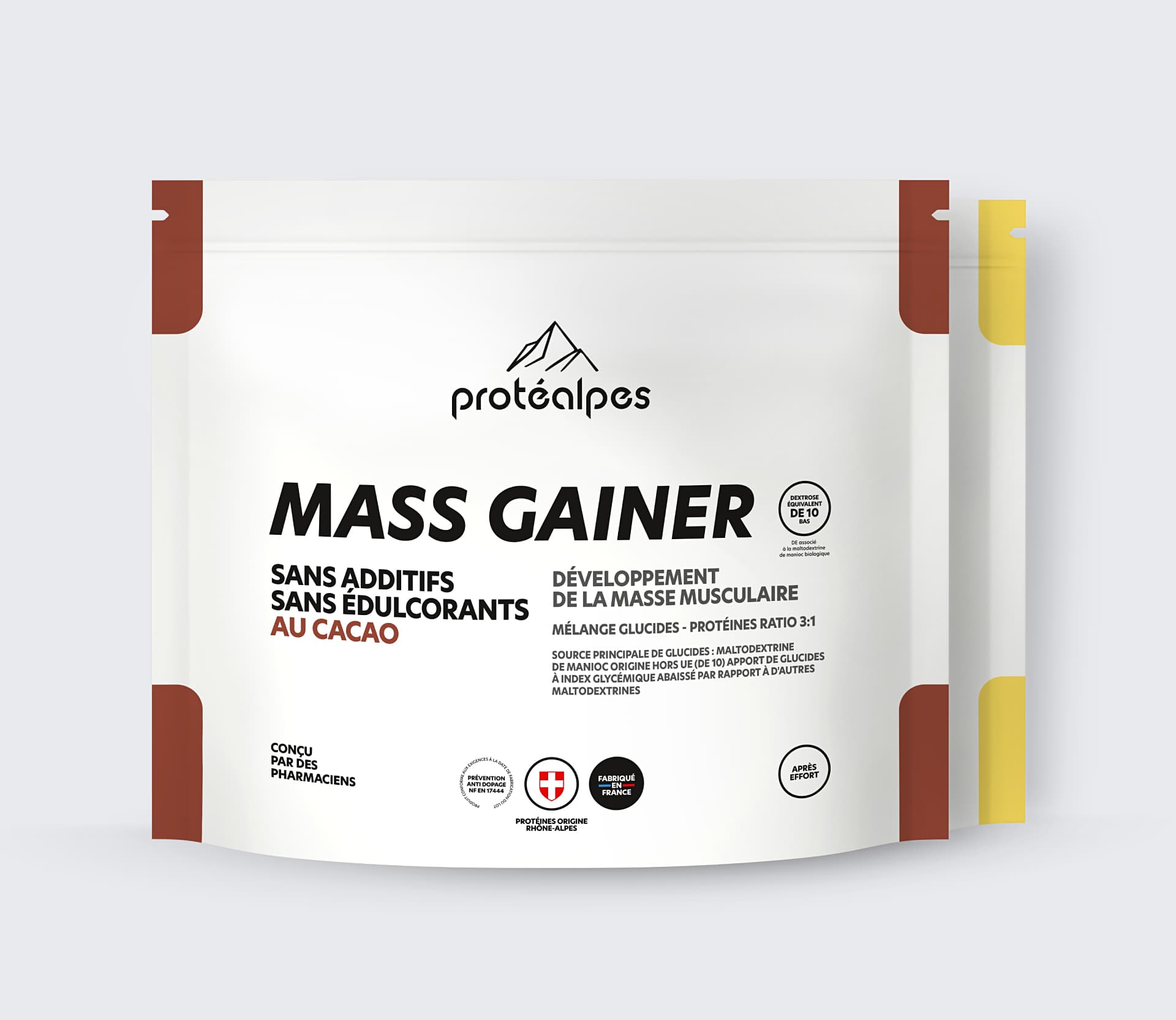
Mass gainer 2 kg
Ideal for weight gain
- Doping substance-free
- No additives, no sweeteners
- Manufactured by Protéalpes in Albertville, France
- 380 kcal and 23 g of protein per serving
What foods promote weight gain in women?
Foods rich in high-quality protein include:
- meat;
- fish;
- eggs;
- dairy products;
- legumes.
Some supplements, such as whey, are naturally rich in BCAAs. These optimize protein absorption after exercise. It is a useful supplement for those who find it difficult to meet their protein requirements through diet alone.
They are among the highest quality organic protein sources available for supplementation.
The challenges of sports nutrition
Sports nutrition impacts muscle gain and athletic performance in general. A balanced and varied diet provides vitamins, minerals, and other essential nutrients. These nutrients support muscle growth and theoverall healthof athletes.
That's why an athlete's meals should include a variety of nutrient-rich foods.
Lipids and athletic performance
Healthy fats are rich in omega-3, EPA, and DHA. They are found, for example, inolive oil, rapeseed oil, avocados, and fatty fish such as salmon. They contribute to proper hormonal function and aid in the absorption of fat-soluble vitamins.
Athletic performance requires lipids for their role inreducing inflammation. They are an essential part ofrecoveryafter training sessions.
Carbohydrates and weight gain
Carbohydrates are better known as carbs. This family of macronutrients is another component of sports nutrition. This raises the question of whether it is importantto increase their quantity when bulking up.
Carbohydrates provide the energy needed for intense training sessions and support muscle recovery. Here are three sources of complex carbohydrates to prioritize for a stable and sustainable energy supply:
- whole grains;
- oat flakes;
- sweet potatoes.
Here again, the right balance is important. Too many carbohydrates can lead to unnecessary weight gain. Conversely, a lack of carbohydrates can hinder your ability to sustain intense, regular exercise.
For weight gain, low glycemic indexes are preferred, through complex carbohydrates or gentle cooking methods.
Water for muscle gain
Hydration is underestimated, but vital for performance. Drinking enough water helps to:
- maintain performance;
- regulate body temperature;
- assist in the transport of nutrients throughout the body.
Female athletes in the muscle hypertrophy phase should drink throughout the day, especially around training sessions.
Plants in the calorie balance
Fruits and vegetables, rich in vitamins, minerals, and fiber, contribute to a balanced diet. These plants support essential bodily functions, including those related to physical exertion and recovery.
For example, oranges (rich in vitamin C) and spinach are very beneficial for athletes.
For effective weight gain, it is important to consume enough calories and protein, but that's not all.
You also need to eat a balanced and healthy diet. This includes foods that are suitable for muscle growth, to maintain good health and optimize performance.
Whey protein for women gaining weight
There are many dietary supplements for hypertrophy. Among them, creatine and whey are the most commonly cited.
Whey protein is a popular dietary supplement in the world of sports. This whey is appealing for its high quality and effectiveness in supporting muscle building.
Its role goes far beyond simply providing protein. Whey offers several benefits for women looking to optimize their weight gain. As an added bonus, it limits fat accumulation.
It is not essential for building muscle. However, here are its main benefits.

Why does whey protein help build muscle?
Whey protein supplements a normal diet, especially for athletes. It provides them with a concentrated source of high-quality protein. It therefore compensates for any protein deficiencies in a traditional diet. It also provides essential amino acids, which are necessary for muscle repair and growth.
For athletes with increased protein requirements, whey makes it easier to achieve nutritional goals. It does this without overloading the body with extra calories.
Its ease of assimilation makes it an optimal choice for supportingmuscle recovery and optimizing performance.
Whey for lean mass gain
For those aimingto gain lean muscle mass, whey protein is particularly suitable. It helps increase muscle mass without adding excess fat, which is the challenge when trying to lose weight.
It also provides the same high-quality protein intake with minimal calories, sugar, and fat. This meets high protein requirements without exceeding the recommended daily calorie intake.
Whey thus facilitates the management ofthe muscle/fat ratio.
How to incorporate whey into your diet
Incorporating whey into your daily diet is simple and convenient.
It can be consumed as a protein shake by mixing the powder with water or milk. This makes it a convenient snack to include in your post-workout routine or for snacks between meals.
Weight gainers provide a useful calorie intake of protein and carbohydrates for weight gain.
It is also possible to enrich recipes with whey to make them higher in protein.
Finally, it is important to know the criteria for choosing the best whey for women. Look for a product without additives, made locally and cold-filtered from good quality milk.
Whey Protein
- Manufactured in-house by Protéalpes
- No additives, no sweeteners
- Protein isolate from Rhône-Alpes
These professional clubs put their trust in us:







How to plan your weight gain training program?
For women aiming to gain muscle mass, it is important to understand certain fundamental training principles. It is essential to choose the right exercises, but also to structure your workouts. This is the only way to maximize muscle growth and minimize fat gain without risking injury.
Structuring training sessions
Resistance training is the cornerstone of effective muscle gain. Compound exercises, which work several muscle groups, are beneficial. Examples include deadlifts, squats, lunges, etc. These movements work a large part of the body. They also stimulate the release of hormones that promote muscle growth.
The frequency of sessions must be adjusted to allow for optimal recovery. Rest periods are essential for muscle recovery, which promotes growth.
While each woman needs an individualized approach to perform, the scientific literature provides guidelines. Here is a summary table of recommendations for strength and power resistance training for women¹:
| Subject of the recommendation | Beginner to intermediate athletes | Experienced athletes |
|---|---|---|
| 1. Terms and conditions of the program | Multimodal approach combining: strength + plyometrics + speed + agility + flexibility, depending on individual needs | Multimodal approach combining: strength + plyometrics + speed + agility + flexibility, depending on individual needs |
| 2. Muscle contractions | Varying contractions: • Concentric (traditional repetitions); • Eccentric contractions to develop strength and hypertrophy; • Isometric contractions through stabilization, grip, pauses, and holds. | Varying contractions: • Concentric (traditional repetitions); • Eccentric contractions to develop strength and hypertrophy; • Isometric contractions through stabilization, grip, pauses, and holds. |
| 3. Types of exercises | Focus on movements: • primarily multi-joint; • single-joint as a supplement … with free weights/accessories: machines, kettlebells, balls, etc. Alternate exercises: • unilateral and bilateral; • corrective and functional (core-hips, shoulders, pelvic floor, shoulders, etc.) In the basic program: squats, lunges, pushes, pull-ups, hip flexions, weight carrying, stabilization, rotations, hamstring work. Give preference to upper body exercises. | • Incorporate Olympic movements (reverse kinetic progression) • Diversify accessories: kettlebells, TRX straps, chains, elastic bands, • Program exercises in the three planes of motion |
| 4. Training structure | Full-body 2-3 times per week Option to vary between: • complete training program; • upper or lower body split programs; • muscle group programs | Full-body 4-6 times per week Vary between: • complete training program; • upper or lower body split programs; • programs by muscle group |
| 5. Order of exercises | • Large muscle groups → small muscle groups • Multi-joint → single-joint • High intensity → low intensity Option to alternate between upper and lower body or to intersperse exercises with movements that target other muscle groups. | • Olympic lifts first (if strength is the goal) • Then basic strength exercises • Complex → simple Possibility of interspersing exercises to optimize recovery |
| 6. Expenses | • 60-70% of 1RM for 8 to 12 repetitions per set for the program's key exercises; • Light weights for learning technique or corrective exercises. • Individualized approach to weight allocation. • Body weight is sufficient for certain exercises. | • 80-100% of 1RM for key exercises in the program; • Training based on possible execution speed (with light loads) • Individualized approach to load allocation. • Body weight is sufficient for certain exercises. |
| 7. Volume | • 3 to 6 sets per exercise; • 15+ reps at low to moderate load: builds strength in less trained individuals and promotes endurance and hypertrophy; • Moderate loads sufficient for initial strength gains; • Volume and intensity are inversely proportional. | • 3 to 6 sets per exercise; • 1 to 6 reps with heavy weights for maximum strength; • 8-15 reps possible but slower gains • Volume varies depending on goals; |
| 8. End of the series | • Maximum strength gains are achieved when sets are performed to failure and stopped befor • Failure is preferable for gaining muscular endurance and hypertrophy. | • Stop before failure for maximum strength; • Failure is preferable for gaining muscular endurance and hypertrophy. |
| 9. Rest | • 1-2 minutes for assistance exercises; • 2-3 minutes minimum for heavy exercises; • Short rest periods for muscular endurance; • Women recover faster: rest periods should be adapted individually; • Muscle hypertrophy involves a range of rest periods, both short and long. | • Minimum 2-3 minutes for heavy, structural, and Olympic exercises; • Intra-set breaks (10-30 seconds) to maintain strength/power performance; • Muscle hypertrophy involves a range of rest periods, both short and long. |
| 10. Speed of execution | • Depending on the load; • Speed continuum • Intention to speed up during the concentric phase • Moderate to fast for assistance (1-2s EXC, 1-2s CON) • Unintentionally slow with heavy loads | • Depending on the load; • Speed continuum • Intention to speed up during the concentric phase • Moderate to fast for assistance (1-2s EXC, 1-2s CON) • Unintentionally slow with heavy loads |
| 11. Frequency | • 2-3 days/week (full-body) | 4 to 6 days/week (depending on the integration of resistance training with other modalities or depending on the competition period) |
Be mindful of the volume and intensity of your training
Training volume represents the total number of repetitions ( ) multiplied by the number of sets, depending on the weight used. It is a determining factor in muscle gain.
Too low a volume does not stimulate the muscles enough to induce growth. Conversely, too high a volume leads to overload and overtraining. Finding the right balance is therefore essential if you want to build muscle.
The intensity must also be high enough to challenge the muscles without compromising form and technique. Some studies show that women spontaneously choose weights that are too light (41-48% of 1 RM). However, they are more likely to choose 50-57% of 1 RM when accompanied by a coach.
This underestimation of their capacity is a limiting factor in their muscle gain.
Gradually increasing your workload is important formuscle hypertrophy.
Here are a few pointers to help you achieve this:
- If you can easily do 15 to 20 reps, the load is too light.
- Aim for 8 to 12 repetitions, with the last 2 or 3 being the most difficult to complete in order to find the right load.
Focus on the upper body
Women have on average 50-60% of the upper body strength of men. For the lower body, the percentage rises to 65-70%. However, greater relative strength gains are possible for the upper body¹.
In other words, women neglect their upper bodies, even though this is where they have room for improvement and need to build volume. This is why working on the chest is important and recommended:
- avoid doing only squats and glute exercises;
- to incorporate (as much or more) volume for the back, shoulders, chest, and arms.
The upper body responds very well to training in women. And there is no risk of becoming "too" square.
The importance of recovery
Recovery is just as important as the training itself. Without adequate rest, muscles cannot repair or strengthen.
Rest is an integral part of the weight gain program. It serves to maximize recovery.
To support muscle growth and overall health, it is recommended to:
- include full rest days;
- Ensure you get quality sleep.
Conclusion
To successfully gain weight as a woman, every factor counts. It is especially important to eat a suitable diet and exercise regularly. Every meal designed for weight gain, from breakfast to dinner, supports this goal.
A protein-rich diet should be accompanied by whole carbohydrates (cooked rice, sweet potatoes, whole grains) and healthy fats. Weight gainers, creatine, and protein bars can help, but whey is particularly suitable. Consulting a nutritionist can shed light on the diet plan to follow to gain weight.
When training, recovery between sets is just as important as bench press repetitions. Rest between each weight training session should be included in your schedule. Working on muscle strengthening by varying your exercises will stimulate growth
This period of weight gain requires discipline and consistency, but it also builds self-confidence.
Scientific references and sources
2 The menstrual cycle phase does not influence muscle protein synthesis or whole-body myofibrillar proteolysis in response to resistance exercise. by Lauren M. Colenso-Semple et al.
To find out more :