





In 2025, the UFC Que choisir survey sounded the alarm about a contaminated product: chocolate. Cocoa was the focus of this health debate because of its toxicity. Its contamination with cadmium, a heavy metal found in soil, was cause for concern.
As a result, consumers are cautious and hesitate when they want to enjoy a square of chocolate, even organic chocolate. Similarly, some amateur athletes who enjoy cocoa-flavored whey are questioning their powder.
What do we know about this contamination? Should we be concerned about the amounts of cadmium in cocoa powder or whey sold? At Protéalpes, we are demanding when it comes to our formulations, which comply with European Union standards. Performance requires complete confidence in what we consume. Here we reveal our figures to guarantee quality manufacturing and production.
So, let's see why cadmium and cocoa are linked, and then how to avoid their presence in our bodies.
In a nutshell
- Present in the volcanic soils of South America, cadmium accumulates in cocoa, leading to increased vigilance regarding chocolate products. Potential contamination also from fertilizers.
- European regulations are strict: they limit the maximum cadmium content to 0.6 mg/kg for cocoa powder.
- Protéalpes cocoa whey: levels 20 times lower than the standards. Analyses reveal only 0.03 mg/kg of cadmium, confirming a transparent, traceable formulation that complies with European Union requirements.
- : Protéalpes relies on its suppliers for a sustainable, traceable supply chain, limiting the presence of heavy metals while preserving taste and nutritional quality.
- Low risk with a balanced diet. According toANSES, only excessive consumption of cocoa products (chocolate, cookies, cereal) can pose a problem. Whey with cocoa remains safe for athletes.
Contents
- Why are we talking about cadmium in cocoa?
- Which foods contain cadmium?
- Why is chocolate being singled out?
Why are we talking about cadmium in cocoa?
Cadmium, a naturally occurring heavy metal
Cadmium (Cd) is a soft, malleable transition metal. Its physical and chemical properties enable it to cross biological barriers. This is why it accumulates in:
- the land;
- air;
- water;
- and in food.
Thisnatural elementfound in soil is also used in industrial processes. The jewelry, aeronautics, nuclear, and electrical materials sectors use it in the manufacture of alloys, batteries, etc.
In addition,human activity contributes to its increased presence in our bodies through the use of fertilizers in agriculture.
What does this have to do with food? Plants and certain foods absorb cadmium through their roots and contribute to the contamination of our bodies.
In addition, inhaling tobacco also exposes people to cadmium, putting smokers at risk of excessive consumption.
Which foods contain cadmium?
A lot, and that's the problem. The accumulation of cadmium from all the foods concerned exposes people to levels above what is tolerable for the body. ANSES estimates exposure at 0.6% for adults, 14% for 3-17 year olds, and 36% for 0-3 year olds (2023 figures).
Cadmium is found in:
- a bar of organic dark chocolate;
- bread;
- cereals;
- chocolate cookies;
- certain vegetables such as spinach;
- offal and other seafood products.
Why is chocolate being singled out?
Cocoa trees are trees that produce the beans used to make cocoa. Most are located in volcanic regions of South America, such as Peru and Ecuador. This is where cadmium is naturally very present.
The origin of the cocoa beans and the cocoa manufacturing process therefore have an impact on the cadmium content. This also explains why chocolate is singled out, even organic chocolate.
What are the regulations on cadmium in cocoa?
France complies with very strict European regulations regarding cadmium.
Highly regulated European legislation
Regulation (EU) 2023/915of April 25, 2023 precisely regulates the maximum cadmium content in foodstuffs.
Here are some examples ofcadmium thresholdsfor cocoa:
| Cadmium | Maximum content (mg/kg) |
|---|---|
| Celeriac | 0,15 |
| Food supplements | 1 |
| Chocolat au lait avec < 30% de matière sèche totale de cacao | 0,10 |
| Chocolat avec < 50% de matière sèche totale de cacao ; chocolat au lait avec > 30% de matière sèche totale de cacao | 0,30 |
| Chocolate with > 50% total dry cocoa solids | 0,80 |
| Cocoa powder marketedto the end consumeror as an ingredient in sweetened cocoa powderor chocolate powder marketed to the end consumer (chocolate drink) | 0,60 |
These values provide amargin of safety forconsumers.
How much cadmium is there in chocolate?
Dark chocolatecontains more cocoa than milk chocolate. As a result, the cadmium content may be higher. Sugar and milk tend to dilute cadmium concentrations. It may be tempting to opt for milk or white chocolate instead. However, these contain higher levels of sugar and are therefore not better for your health.
The levels found in products on the market vary greatly. They are normally within European standards, i.e.,below 0.60 mg/kg.Reputable brands publish their analyses to ensure transparency for their customers.
Protéalpes cocoa whey has a threshold of0.03 mg/kg.
The problem is not the consumption of chocolate or cocoa itself. It isthe accumulation of products containing cadmium that causes excessive absorption rates.
That is why nothing beats a varied and balanced diet to reduce your exposure threshold.
Whey chocolate
A unique whey
- Manufactured by Protéalpes in Albertville, France
- No additives, no sweeteners
- With lean, non-alkalized, certified organic and fairtrade cocoa powder

Does this apply to Protéalpes cocoa whey?
Protéalpes is a French brand created by two pharmacists who are passionate about outdoor sports. Transparency is at the heart of our concerns, to reassure athletes about the quality of the products we sell.
Here is all the information about the cadmium levels in our whey products , particularlythose containing cocoa.
Increased vigilance on cocoa
Protéalpes usesnon-alkalized organic cocoain its formulations. The products therefore contain no alkalizing agents such as potassium carbonate. Potassium carbonate is used to modify the appearance or taste of cocoa. Our processes therefore avoid any chemical treatment in order to preserve thenatural qualityof the cocoa.
It should be noted that the majority of products (even organic ones) that contain cocoa powder use alkalized powder to enhance the taste, color, or stability of the cocoa. Natural powders are more difficult to source because they are less common. Choosing a non-alkalized powder means committing to a truly raw and natural product.
What's more, the cocoa powder used isFairtradecertified. This independent label goes beyond its initial ethical and social dimensions. It promises consumers quality andtraceabilityof the raw materials used, including cocoa.
For Protéalpes, this traceability facilitates thecontrol of heavy metalssuch as cadmium, because we know where each harvest comes from. The rigor of the label ensures the reliability of the monitoring and analysis carried out onProtéalpes Whey cocoa. And thatsecures oursupply chain.

A new supplier to ensure quality
We are changing suppliers in order to ensure even greater traceability with regard to heavy metals. We now work with several companies that all meet our quality standards and philosophy.
The main focus of our vigilance regarding heavy metals is on the presence of cadmium, which is strictly limited to less than 0.6 mg/kg in the raw product. Other wholesalers, even organic ones, cannot always guarantee such low thresholds.
Very low measured thresholds
Cadmium is only present in cocoa. All other whey flavors offered, except cocoa/red berries, therefore technically contain no traces.
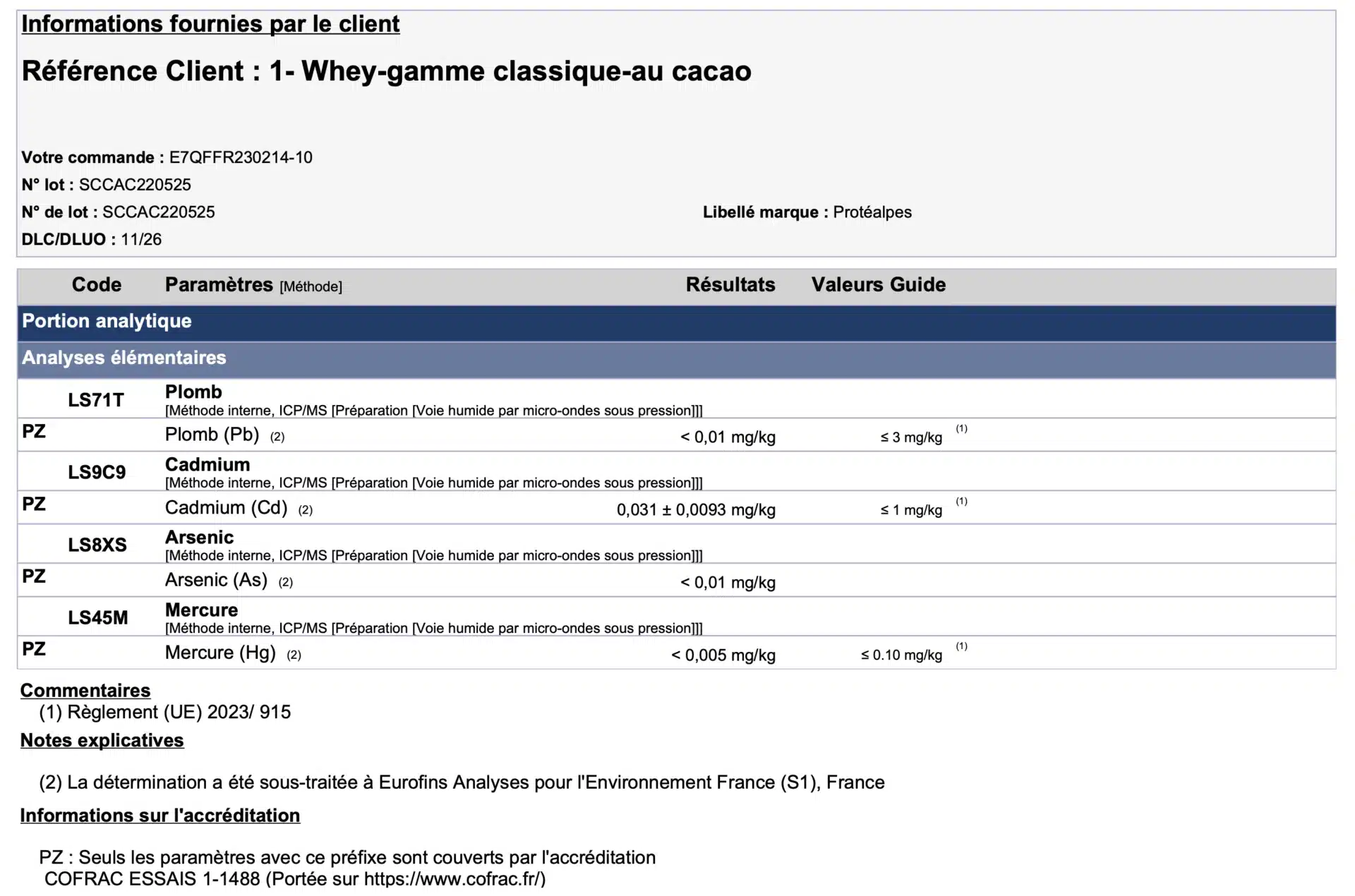
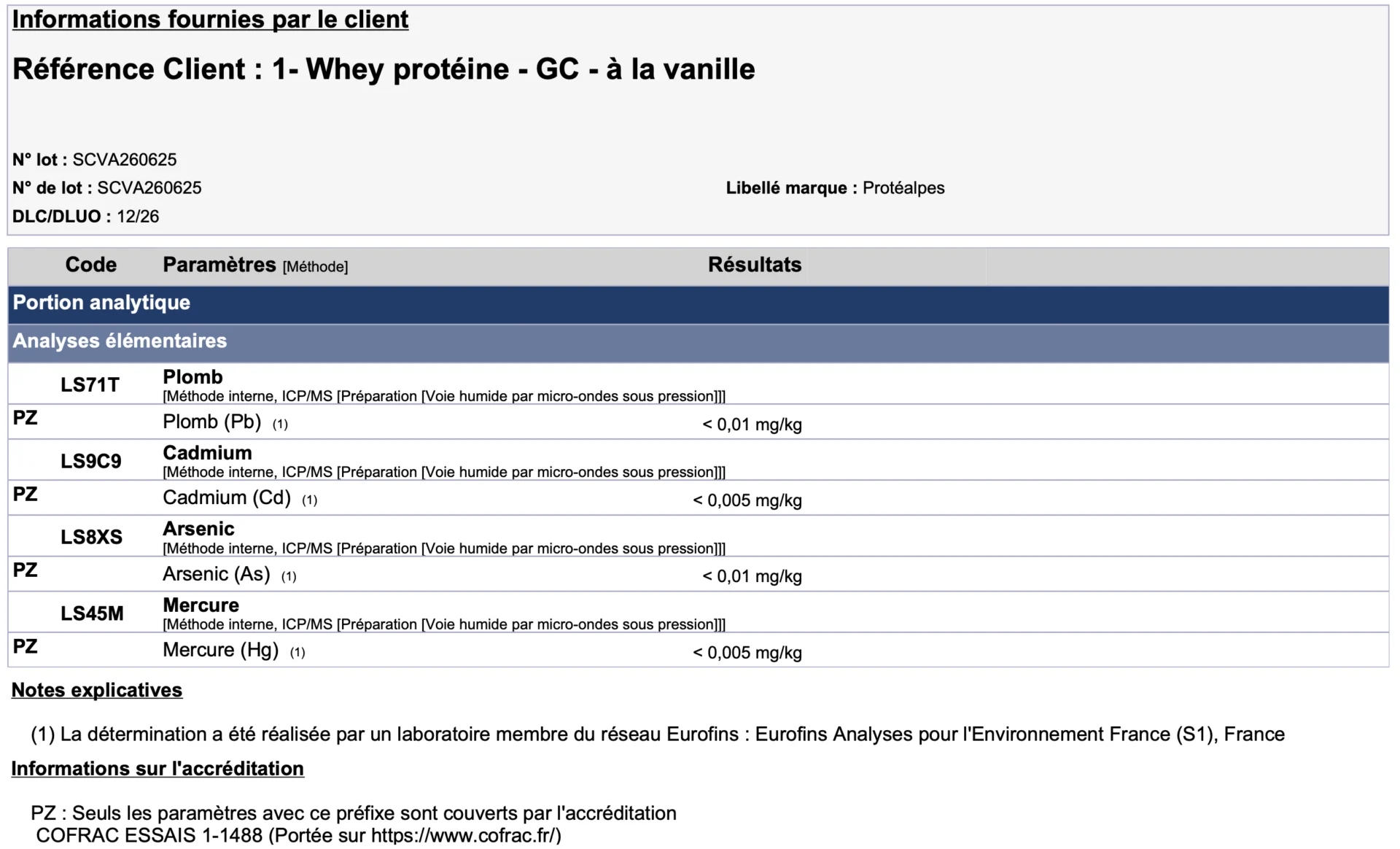
Our analyses prove it:
- OneProtéalpes cocoa whey contains0.03 mg/kg ofcadmium.
- The other flavors shownodetectabletracesaccording to the Eurofins laboratory.
A transparent approach to ensure traceability
Protéalpes is therefore20 times belowthe European regulatory thresholds (0.6 mg/kg for this type of product). An athlete who consumes 30 g of whey per day is therefore well below the tolerable weekly intake.
The brand's aim is notto settle for the minimum regulatory threshold, but to strive for the lowest possible thresholds. We monitor all our products in this regard. We therefore promise our consumers healthy raw materials and a responsible manufacturing chain.
Whey protein
- Manufactured in-house by Protéalpes
- No additives, no sweeteners
- Protein isolate from Rhône-Alpes

These professional clubs put their trust in us:












The health risks of cadmium: should we be concerned?
Why is high-dose cadmium monitored?
Yes, there are health risks associated with consuming too much cadmium.
The 2017 ANSES expert report recommends a maximum daily dose of0.35 µg/kg/day. This corresponds to a maximum dose of2.45 µg/kg/week.
Above this level, chronic exposure can cause:
- kidney or bone damage;
- pancreatic, bronchopulmonary, liver, or kidney cancers;
- fertility and fetal development issues.
The limit of cadmium exposure with cocoa
To reach excessive cadmium consumption levels, you would have to eat enormous quantities of cocoa alone every week (between 200 and 600 grams).
Chocolate alone accounts for only a small part of average exposure. The problem lies inthe accumulation of chocolate, chocolate cookies, breads, and cereals over the course of a single week. Moreover, it is very difficult to calculate the exact amount of cadmium consumed in total over a week.
RegardingProtéalpes cocoa whey, analyses indicate a level of0.03 mg, or 30 µg per kilogram of powder. A30 gservingof whey(a typical post-workout dose) therefore corresponds to0.9 µg of cadmium. Given that the limit of 2.45 µg/kg/week represents 175 µg for a 70 kg adult, one dose of whey is equivalent toless than 0.5%of the weekly dose. So even if you consume it every day of the week, you are well below the safety limits.
Once again, this type of reasoning is limited, as our diet must be varied. This is also the recommendation of ANSES (the French Agency for Food, Environmental and Occupational Health & Safety) to reduce exposure to cadmium.
Why are children more affected?
Children weigh less. This makes them more sensitive to cadmium, because with the same intake, their tolerance threshold is reached more quickly.
Once again, if their diet is balanced, cocoa poses no problem.

In practical terms, what does this mean for athletes?
For athletes, the presence of cadmium in cocoa does not affect the safety of Protéalpes whey.
Protéalpes cocoa whey is safe
The content of our Whey is0.03 mg/kg, which is20 times lower thanthe European limit. A30 gservingof Protéalpes cocoa wheycontains anegligible amount, even when consumed daily.
Other Protéalpes fragrances
The other flavors available (vanilla, red berries, plain) containno detectable tracesof heavy metals.
We carry outregular analyses onour products. We also ensurecomplete traceabilityof raw materials, from the bean producer to the whey shaker. Our supplement is therefore suitable for athletes who are extremely demanding when it comes to the quality of the food they consume.
Our ambition to produce ultra-controlled cocoa for demanding athletes
At Protéalpes, we believe thatsports nutritionshould combine performance, transparency, and responsibility. Our choice of Fairtrade non-alkalized cocoa follows this logic, thanks to our suppliers, whom we select for their responsible supply chains.
Beyond controlling our products, we believe in creatingsustainable supply chainsfor sports. We also strive for greater collaboration between producers and sports brands.
Our goal remains to offer, above all, high-quality,healthy dietary supplements. We want them to be as respectful of the environment as they are of athletes' health.
Conclusion
Cadmium is a toxic heavy metal that occurs naturally in certain soils, particularly in Latin America. The problem is that this geographical area accounts for a significant proportion of global cocoa production.
Used in agriculture in certain phosphate fertilizers, it can seep into and end up in cocoa paste. Given the health risk, the European Union has set strict thresholds and a daily dose to limit harmful effects on health, especially in children.
For adult athletes who consume cocoa-flavored whey, Protéalpes guarantees controlled batches and independent certifications (such as the Fairtrade label). The aim is to assure consumers that products are fully compliant and well below the reference values.
Our approach: transparency, traceability, and high standards for sustainable cocoa.
To find out more :