






Two processes produce the whey protein commonly consumed by athletes. The origin of the protein raw material changes the manufacturing process and the price, but not the actual muscle-building effect.
Here's what science really says.
In a nutshell
- The right choice should be based on the origin of the milk, the gentleness of the process, and the absence of additives—not necessarily on the label "native."
- The difference lies in when the proteins are extracted from the milk: before the casein coagulates for milk whey, and after for cheese whey.
- Cheese whey comes from the whey produced during cheese making. Milk whey (known as native whey) is extracted directly from whole milk.
- No studies demonstrate that milk whey is superior to cheese whey in terms of muscle protein synthesis.
- The difference in leucine content does not translate into greater mass gains.
Where do proteins come from?
Milk contains two families of proteins: caseins (80%) and whey proteins (20%). Whey comes from this second fraction. It is naturally rich in essential amino acids and BCAAs.
Cheese whey: during cheese production, rennet is added to coagulate the casein. The remaining liquid, whey, contains whey proteins. It is then filtered (ultrafiltration, microfiltration) to concentrate the proteins and remove lactose and fat. This is the standard in the sports nutrition industry.
Dairy whey (native): skimmed milk is filtered directly, without prior coagulation. Whey proteins are separated by cold microfiltration. The subsequent steps (concentration, drying) remain identical to those for cheese whey.
The only difference between these protein powders is when the protein is extracted: before or after casein coagulation. Not the intrinsic quality of the final product.

Is cheese whey a waste product?
The word "waste" is a marketing argument frequently used by producers of so-called native whey to tarnish the image of cheese whey. Whey was indeed undervalued until a few decades ago, due to a lack of suitable technology and outlets.
Whey proteins are naturally the richest source of essential amino acids per gram of protein.
Calling them "waste" makes no sense from a nutritional point of view. Whey has always been consumed in Alpine villages for its nutritional properties.
Today, it is a co-product whose market price is rising every year.
Composition: is there really a difference?
Industrial data show a minimal difference in nutritional composition between the raw whey obtained:
| Criteria | Cheese whey | Dairy whey |
|---|---|---|
| Leucine | 10-11 g/100 g | 12-13 g/100 g |
| EAA/BCAA profile | Complete | Complete |
| Bioavailability | High | High |
What science says: A randomized clinical trial compared native whey (richer in leucine) and WPC-80 cheese whey after training (2 × 20 g of protein).
Result: Despite slightly higher plasma leucine levels with native whey, muscle protein synthesis was identical over 5 hours.
The reason is simple: leucine triggers protein synthesis, but beyond 2.5-3 g per dose, increasing the dose does not provide any additional benefits.
Both types of whey exceed this threshold at 20-25 g of protein. For muscle growth, it is the total daily protein intake and training that matter, not the extra gram of leucine.
The issue of GMPs (glycomacropeptides)
The only objective difference between the two whey proteins is the presence of GMP in the cheese version. These molecules are formed when rennet is added.
Some manufacturers of native whey have presented them as dangerous, based on a 2001 study of premature infants. This reference is obviously unsuitable for an adult audience.
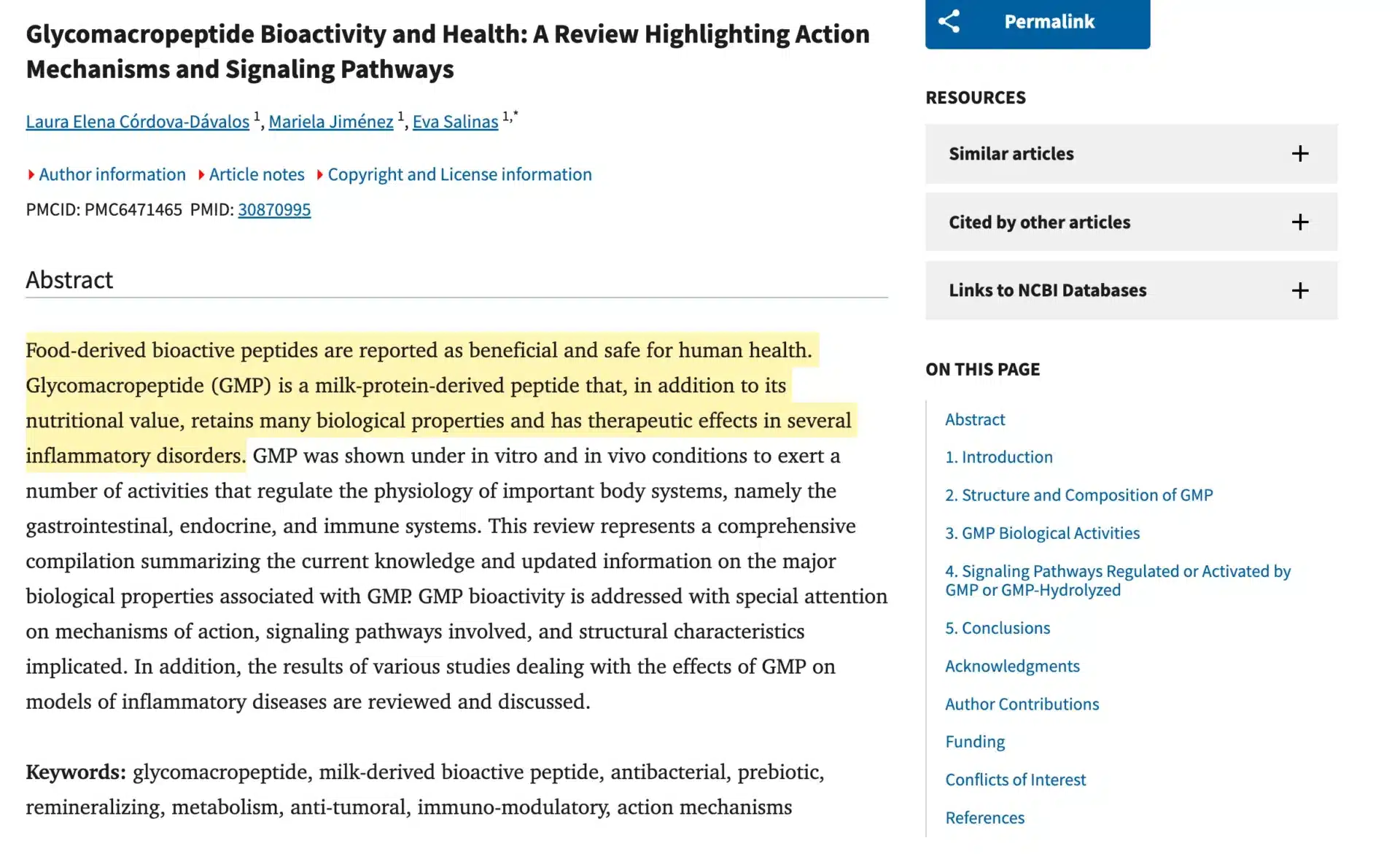
Recent studies show that GMPs are not only safe, but beneficial: gastrointestinal regulation, effects on the endocrine and immune systems. The presence of GMPs in cheese whey is not a problem—it is potentially an advantage.
Denaturation: native = undenatured?
The main marketing argument used by manufacturers of native whey is based on confusion, or rather an inappropriate shortcut.
A protein is said to be denatured when it has lost its original structure. The term may seem negative at first glance, but we have been eating denatured proteins since time immemorial: cooking, for example, is a process that greatly denatures food. A roasted chicken is no less nutritious than a raw chicken, and eating it this way is not considered problematic.
In nutrition, proteins are broken down in the digestive tract to recover amino acids. It is this raw material that is used for muscle recovery or development, not the native structure of the protein.
The potential problem: native whey can be pasteurized at high temperatures, dried with preheating, and formulated with additives. All of these are sources of denaturation. Native whey can therefore be more denatured than well-produced cheese whey.
What limits denaturation: gentle pasteurization, cold microfiltration, low-temperature drying. These criteria apply to both types of whey.
It is obviously preferable, in general, to influence the raw material as little as possible and therefore to limit its denaturation, but this applies to any product intended for consumption. However, in this case, the denaturation highlighted against cheese whey makes no sense given the intended purpose.
Price: why is native advertising more expensive?
The cheese factory adds value to an existing by-product, whereas milk whey requires dedicated facilities and generally yields lower returns.
Average prices observed (French brands):
- Native whey isolate: ~€60/kg (up to €79/kg for organic)
- Whey isolate from cheese: ~€50/kg
- Native whey concentrate: ~€45/kg
The 20-40% extra cost is not justified by any proportional muscle gain. High-quality cheese whey offers exactly the same results as an equal dose of protein powder.

How to choose wisely?
The term "native" is purely a marketing term, with no established regulatory framework. Whey can be native and still come from poor-quality milk.
Here's what really matters to us:
Origin of milk: French, from extensive farming, pasture-raised cows, full traceability. The quality of the raw material determines the quality of the final product and the value of the industry.
Manufacturing process: cold microfiltration, gentle pasteurization, low-temperature drying. These elements limit denaturation, whether the whey is native or cheese whey.
Formulation: no additives or sweeteners, short list of ingredients. Artificial flavors and sweeteners are other sources of denaturation after reconstitution that can cause digestive discomfort and, in the long term, certain health problems.
Manufacturer transparency: in-house manufacturing control, available information on processes, certifications (GMP, anti-doping).
Our commitment: to prioritize whey sourced from high-quality French milk, free from additives and sweeteners, and produced using controlled manufacturing processes. This is what makes a real difference to your recovery and long-term health.
Furthermore, animal welfare and respect for the environment are concepts that often go hand in hand with the characteristics mentioned above in a "win-win" pact between the upstream and downstream parts of the value chain.
Whey protein
- Manufactured in-house by Protéalpes
- No additives, no sweeteners
- Protein isolate from Rhône-Alpes

These professional clubs put their trust in us:












Scientific references and sources
2Glycomacropeptide Bioactivity and Health: A Review Highlighting Action Mechanisms and Signaling Pathways by Córdoba et al.
3Native whey protein with high levels of leucine results in similar post-exercise muscular anabolic responses as regular whey protein. by Journal of the International Society of Sports Nutrition