



In the space of two decades, the sports nutrition market has exploded. Protein powders long reserved for top-level athletes are now available to the general public. However, with the countless brands of whey and other dietary supplements that have been launched recently, choosing the right whey has become much more difficult.
How do you make the right choice from among the best high-protein food supplements on offer? How can you recognize top-quality whey? Can you rely on a comparison to find exceptional protein powders?
Here are the criteria to consider when choosing your whey and acquiring a product naturally rich in amino acids and BCAAs that will fulfill its promises.
In a nutshell
- The whey market has become more democratic, but quality varies greatly depending on the brand and filtration process used.
- Cheap whey, often imported, contains additives and presents a greater risk of contamination, while others rely on quality, controlled raw materials.
- To choose a quality whey, opt for a short composition, without sweeteners, and check the origin and traceability of raw materials.
- A good whey generally costs between €40 and €55/kg;
Before you start, please note that this article focuses on choosing your whey from the existing brands, and not on the different types of product. If you're interested, we invite you to read our article on the different types of whey entitled "Whey protein, whey isolate, vegetable proteins... which to choose?".
Contents

Can we trust the quality of whey sold on the market?
First and foremost, you need to ask yourself whether you could end up with low-quality whey.
Generally speaking, protein powder producers use the same process to obtain whey. They use ultrafiltration and microfiltration to isolate and recover whey proteins.
Whey is dried to obtain protein powder. The brand will then add other components (unprocessed and/or additives) to give taste and texture to the finished product.
Good to know: the protein content and purity of whey proteins will depend mainly on the quality of the filtrations.
Later, during the manufacture of the finished product, the equipment used to produce whey is often used to prepare other products and food supplements.
Without careful cleaning, undesirable substances can find their way into the whey. Contamination with doping products is possible, notably via pro-hormones, which are authorized in some countries.
On the market, even if from a technical point of view,filtration processes are relatively common between brands, there are generally two categories of whey, mainly linked to the origin of their raw materials and their ability to trace production.
Low-end whey
Whey is particularly attractively priced, and is often produced outside the European Union: the composition of these protein powders often reveals significant additive additions.
As we have seen, these additions also expose them to potential contamination by doping substances.
This "entry-level" whey is not necessarily "bad" for athletes or short-term bodybuilding enthusiasts. It's just that the raw materials are potentially of inferior quality. Often, there is no traceability concerning the origin of the main raw materials, such as milk, which may be linked to intensive farming.
Medium- and high-end whey
A whey sold at a slightly higher price, produced by the brand itself, with true traceability of processes. The number of additives varies from brand to brand.
| Whey type | Origin | Additives | Risks | Price/kg |
|---|---|---|---|---|
| Entry-level | Not highlighted | Numerous | Contamination, doping | < 30 € |
| Mid-range | Not highlighted | Moderate | Low risk | ~40 € |
| Top of the range | Spotlight | Moderate or absent | Low risk | > 40/50 € |
At Protéalpes, our whey products are 100% made in France and come exclusively from local, pasture-raised milk from the Rhône-Alpes region, produced by our partner Union des Producteurs de Beaufort. All our products are 100% additive-free.
More than the price or the precise origin of the raw materials, it's the communication and the real traceability communicated by the company that can guide you on the qualitative aspect of such or such brand.
-

Whey Protein - Unidose - No added sugar
Gluten-free, High protein
2,95€
30 g
-

Whey protein with decaffeinated coffee - No added sugar
No added sugar - Zero sweet taste, Gluten free, High protein
34,95€
750 g
-

Whey protein with decaffeinated coffee - Classic range
Gluten-free, High protein, Solvent-free decaffeinated coffee
29,95€
750 g
-

Whey protein vanilla - Classic range
Gluten-free, High protein
29,95€
750 g
-

Whey protein cocoa-red fruit flavour - Classic range
Gluten-free, High protein
29,95€
750 g
-

Whey protein with vanilla - No added sugar
No added sugar - Zero sweet taste, Gluten free, High protein
34,95€
750 g
-

Whey protein with cocoa - No added sugar
No added sugar - Zero sweet taste, Gluten free, High protein
34,95€
750 g
-

Whey protein caramel flavour - Classic range
Gluten-free, High protein
29,95€
750 g
-

Whey protein mint flavour - Classic range
Gluten-free, High protein
29,95€
750 g
-

Whey protein cocoa-red fruit flavour - No added sugar
No added sugar - Zero sweet taste, Gluten free, High protein
34,95€
750 g
-

Whey protein caramel flavor - No added sugar
No added sugar - Zero sweet taste, Gluten free, High protein
34,95€
750 g
-

Whey protein mint flavour - No added sugar
No added sugar - Zero sweet taste, Gluten free, High protein
34,95€
750 g
-

Whey protein strawberry flavour - No added sugar
No added sugar - Zero sweet taste, Gluten free, High protein
34,95€
750 g
-

Whey protein strawberry flavour - Classic range
Gluten-free, High protein
29,95€
750 g
-

Whey Protein - Unidose - Classic range
Gluten-free, High protein
2,95€
40 g
-

Whey protein with cocoa - Classic range
Gluten-free, High protein
29,95€
750 g
Our tips for getting your hands on whey or other high-quality proteins
The quality of whey protein is ultimately judged by the product's composition. While brands systematically highlight the quantity of amino acids or BCAAs, we encourage you to take a close look at the list of ingredients.
Protein powders with few, if any, additives are preferred . In all cases, avoid sweetened whey, i.e. "falsely" sweetened with a sugar substitute, most often sucralose, sometimes aspartame or steviol glycosides. Attention to sucralose is even more important if you wish to cook your whey.
Sucralose, a 100% artificial organochlorine sweetener, can disrupt the perception of sweetness in the medium term, encouraging people to consume more and more sugar in the rest of their diet. It also disrupts the microbiota and has a significant impact on insulin signals.
Secondly, when cooked, sucralose can produce toxic compounds that are dangerous in the short term.
Here are two studies on the impacts of sucralose:
Sucralose, A Synthetic Organochlorine Sweetener: Overview of Biological Issues by Schiffman et al - 2013
Heating of food containing sucralose might result in the generation of potentially toxic chlorinated compounds by Eisenreich et al - 2020
Furthermore, for a brand that promotes local marketing, make sure that the brand is transparent in its advertising and that it has a real foothold in the territory. This means checking in the site's legal disclaimer whether the company actually has a physical address in the territory in question, or whether this is just a marketing strategy.
If this is not the case, you should be aware that a brand selling via e-commerce in an EU country without having a head office in Europe will not be subject to the regulatory controls specific to nutritional supplements in the EU. Even if there are some excellent foreign brands, whey isolate produced in France is a guarantee of basic quality, thanks to the sanitary controls that exist on the territory.
When it comes to transparency and quality raw materials, beware of greenwashing! Find out all you can about the brand you've chosen. Make sure it's true to its values. To do this, you can ask the brand about the quality of its protein powders and other issues, via their contact forms for example. Answers should be clear, fast and to the point. Customers have every right to ask about the products they ingest or plan to ingest. As whey is a product that is consumed in large quantities over long periods, the choice of brand is very important.
Finally, don't hesitate to consult the reviews (guaranteed by a third-party company) shared by athletes.
Some forums feature discussions listing the best whey protein brands. Internet users share their opinions on the products and try to decipher their composition. Here again, beware of clear-cut opinions, but the exchanges and published reviews may help you to see things more clearly.
Athletes' opinions
Can online reviews be trusted?
Most whey reviews or comparisons found online are biased, as their authors earn a commission when a reader buys via their affiliate link.
In other words, they have a financial interest in recommending certain products over others, even if these are not necessarily the best.
As a result, many "tests" or "rankings" favor the brands that pay the most, not those that offer the best quality.
For example, depending on the brand, the average commission ranges from 10% to 25%.
How do you spot a credible review?
For a start, a reliable site or influencer clearly mentions whether it receives a commission or free products.
Example: "This article contains affiliate links, but our tests are carried out independently." Here, it's honest and transparent, no problem.
If nothing is specified, beware.
Plus a good test:
- Compare several brands using the same criteria (composition, digestibility, origin, taste, etc.).
- Quote measurable data (kcal per portion, BCAA content, filtration process, list of additives, etc.).
We also look for an identifiable writer. A serious writer indicates his or her identity, skills or sporting experience. Be sure to check, as many sites falsely claim to be run by a dietician or nutritionist.
Finally, for the more technical, you can check the links present on the page.
1 - Start by right-clicking on the link and opening the inspector.
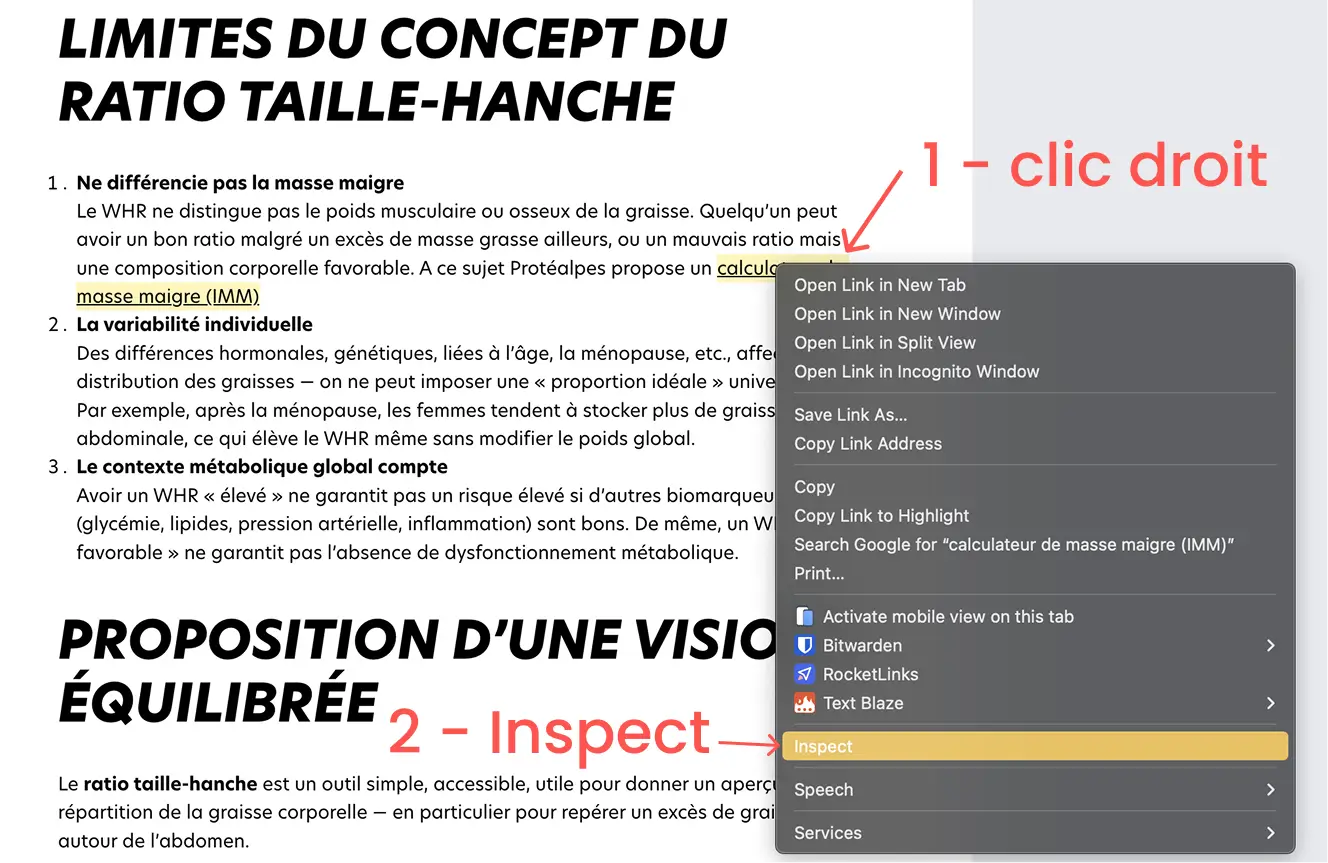
2 - We then observe the construction of the links
We're going to look for elements that indicate link tracking. Here are a few examples of the most common ones in nutrition.
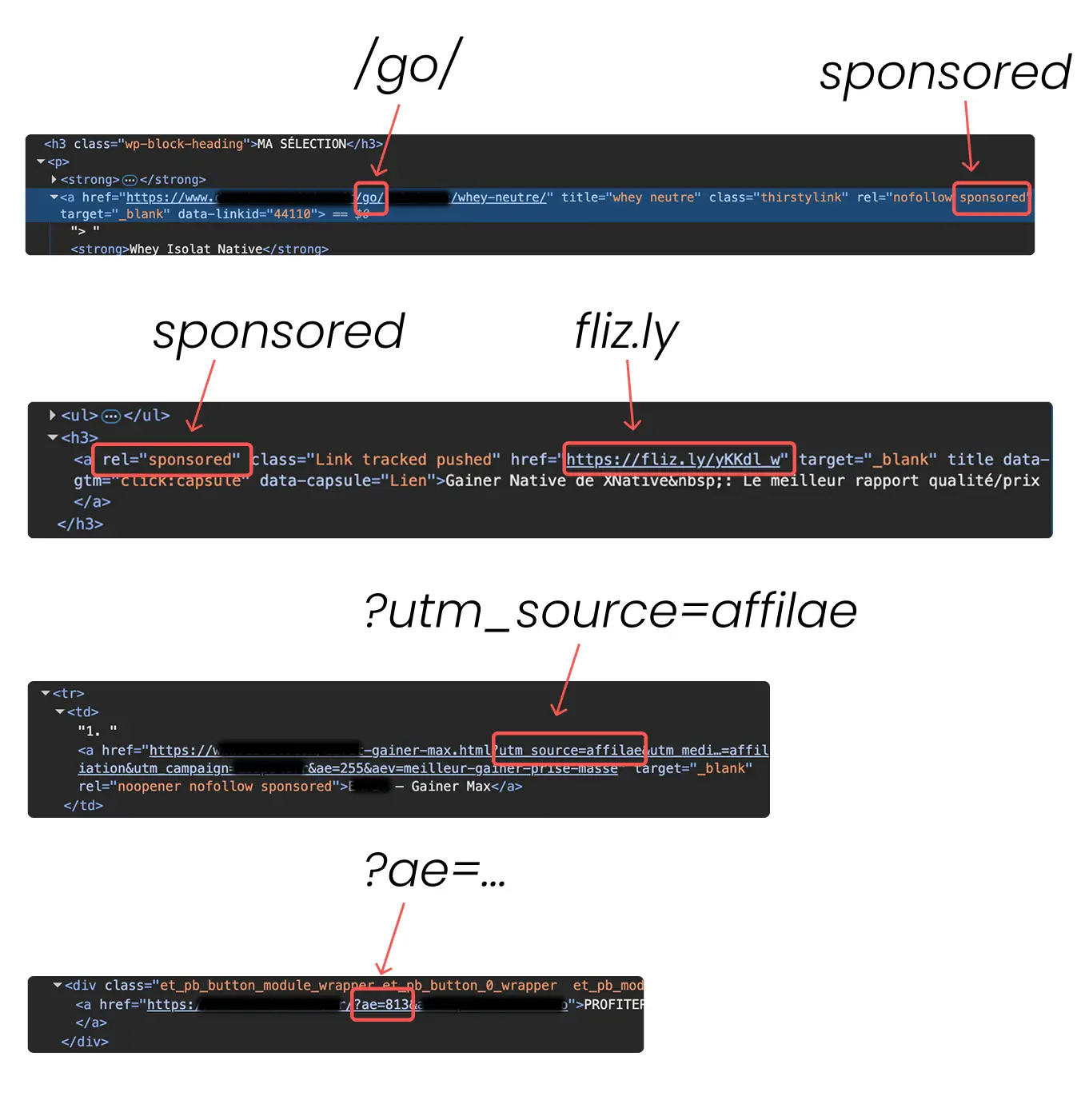
Far from being exhaustive, here is a more complete list:
| Marker / Visible index | What it shows | Meaning / Probable platform |
|---|---|---|
/go/ | Internal redirection to track clicks | ThirstyAffiliates, PrettyLinks, RankMath, etc. |
rel="sponsored" | Link declared as sponsored or affiliated | SEO best practice for reporting a paid link |
rel="nofollow" | Link without transmission of authority (often affiliated) | Frequent on blogs and comparisons |
fliz.ly | Affiliate tracking service | Affiliation platform (e.g. Affilae, Impact, etc.) |
?utm_source=affilae | Marketing campaign follow-up | Affilae platform |
?ae= or &ae= | Affiliate ID | Various platforms (Awin, Effiliation, etc.) |
?affid= or &affid= | Unique affiliate ID | Amazon, ClickBank, etc. |
?partner= | Partnership follow-up | Rakuten, TradeDoubler, or in-house program |
?ref= or ?refid= | Referral or affiliation | Current on fitness, tech, crypto sites |
?tracking= or ?trk= | Customized tracking | Various platforms (Impact, Awin, CJ, etc.) |
?clickid= | Affiliate click ID | Awin, CJ, Impact Radius |
?aff= or &aff= | Affiliate code or partner reference | Generic multi-platform use |
track.webgains.com | Affiliate link via Webgains | European affiliation platform |
tidd.ly | Affiliate link via AWIN | Common in product comparators |
Which whey for which price?
Each brand will have its own pricing strategy. Contrary to popular belief, price is not necessarily linked to product quality. There's nothing to stop an average whey from having an ultra-premium price positioning. On the other hand, price is an important selection criterion, and gives an idea of the brand's positioning. In principle, a specifically low price is not possible for a quality whey, manufactured in-house.
We estimate that a decent quality whey will generally cost between €40 and €55 per kg.
If you're interested in the subject of protein powder pricing, check out our warning about cheap whey. And if your nutrition budget is really low this month, you can even find out how to make your own whey at home!

Is it absolutely necessary to buy a quality whey?
All protein powders formulated for sports nutrition genuinely provide the amino acids and BCAAs essential for mass gain and muscle recovery. When it comes to determining whey quality, this includes assessing the true quality of the raw materials it is made from, as well as exposure to doping risks, digestive problems and various metabolic disorders.
Although they improve the taste and texture of whey, additives also bring their share of disadvantages. In particular, they can induce digestive and/or metabolic disorders over the long term. Derived from the chemical industry, they may contain traces of the solvents used for their extraction, or be mixed with doping substances.
Finally, certain additives such as sweeteners can also be far more harmful than we thought a few years ago, by, for example, getting our taste buds used to perceiving an excessively sweet taste, and having an impact on the insulin system.
Whey protein with whole cane sugar
Formula developed by qualified pharmacists 🔬
- Manufactured in-house by Protéalpes
- No additives, no sweeteners
- Protein isolate from Rhône-Alpes
Also available in packs of 3 to 4.5 kg
To find out more, check out our article on how to consume your whey (quality whey, of course 😉 )!
Are you a professional athlete? Then find out which whey to choose for top athletes!
Not at that level yet, as you've only recently started taking up the sport in earnest? Don't worry, our articles on how to choose your whey when you're a beginner, why consume whey and how to drink whey foam are just for you. And for the curious: is our whey organic?
Test your knowledge!
What is the main process used to obtain whey?
What type of whey is often produced by a company other than the brand itself?
What types of compounds may be present in poor quality whey?
What's important to check when choosing a quality whey?
Which option is most likely for high-quality whey?
What information do whey brands often promote?
Conclusion
In short: choose a European whey, made by the brand itself, with a short composition, no additives, no sucralose, and between €40 and €55/kg. It's the best compromise between purity, taste and long-term safety.